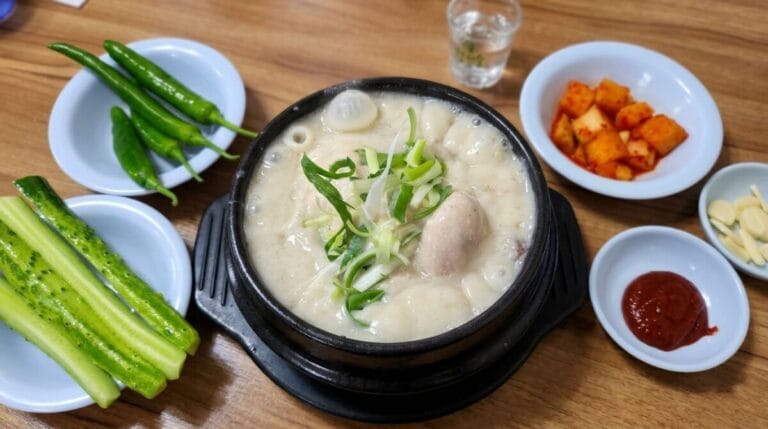
If you want to explore Korean food beyond barbecue, bibimbap, and fried chicken, gamjatang (감자탕) is a dish worth discovering.
Gamjatang is a Korean pork bone stew made with meaty pork bones, vegetables, and a deeply seasoned broth. It is commonly served in a large pot and shared at the table.
The dish is known for its rich pork flavor, tender meat, and distinctive combination of leafy vegetables and seasonings.
Despite its name, which literally translates to “potato soup,” gamjatang is primarily a pork bone dish. Potatoes may be included, but the meat and broth are the main attractions.
For international travelers, gamjatang can initially seem unfamiliar. The large bones, bubbling stew, and Korean-only menus may make ordering more complicated than choosing a typical rice bowl.
Fortunately, understanding a few basic details makes the experience much easier.
This guide explains what gamjatang is, how to eat it, what it costs, and three Korean restaurant chains worth considering.
What Is Gamjatang?
Gamjatang (감자탕) is a traditional Korean stew prepared with pork spine or neck bones, vegetables, and a seasoned broth.
The pork bones are simmered until the meat becomes tender and the broth develops a rich flavor.
Depending on the restaurant, the stew may contain potatoes, napa cabbage leaves, perilla leaves, green onions, and other vegetables.
A distinctive ingredient in many versions is ground perilla seed powder, called deulkkae-garu (들깨가루).
Perilla powder gives the broth a slightly nutty flavor and can create a thicker texture.
Korean chili powder and other seasonings provide additional depth and heat.
Gamjatang is usually served in a large metal pot over a tabletop burner, allowing diners to keep the stew hot while eating.
The dish is particularly suitable for sharing with friends or family.
Why Is It Called Potato Soup?
The Korean word gamja (감자) normally means potato, while tang (탕) means soup or stew.
However, the origin of the dish’s name is not entirely settled.
One explanation connects the name to potatoes, which are commonly included in the stew.
Another explanation associates the term with pork bones.
Because the historical origin is uncertain, it is more accurate to describe gamjatang as pork bone stew rather than simply potato soup.
If you order gamjatang expecting a vegetable-based potato soup, you will receive something quite different.
What Does Gamjatang Taste Like?
Gamjatang has a rich, savory flavor developed from pork bones and seasonings.
The broth can be mildly spicy or quite hot, depending on the restaurant.
Ground perilla seeds often add a nutty, earthy character that distinguishes the dish from other Korean stews.
The meat is usually cooked until it can be separated from the bones relatively easily.
Unlike thin, clear Korean soups, gamjatang often has a substantial broth with vegetables and seasoning.
The combination of meat, vegetables, and hot soup makes it a filling meal.
However, gamjatang is not necessarily suitable for everyone.
The dish contains pork, and the broth may be relatively fatty or strongly seasoned.
If you prefer mild, clear soups, another Korean dish may be a better starting point.
Gamjatang vs. Ppyeo Haejangguk: What’s the Difference?
One of the most useful things to understand before visiting a gamjatang restaurant is the difference between gamjatang and ppyeo haejangguk.
Both dishes commonly use pork bones and seasoned broth, but their serving styles are different.
| Feature | Gamjatang (감자탕) | Ppyeo Haejangguk (뼈해장국) |
|---|---|---|
| Main ingredient | Pork bones | Pork bones |
| Serving style | Large shared pot | Individual bowl |
| Typical order | Small, medium, or large | One serving |
| Best for | Couples and groups | Solo travelers |
| Cooking at table | Often kept hot on a burner | Usually served ready to eat |
| Price structure | Per pot | Per person |
The exact ingredients and seasoning can vary by restaurant.
Which Should You Order?
If you are traveling with friends or family, gamjatang is a good choice because it is designed for sharing.
If you are dining alone, ppyeo haejangguk is usually more convenient.
It provides a similar pork bone soup experience without requiring you to order a large pot.
This distinction is particularly helpful for travelers who want to try Korean pork bone soup without spending more than necessary.
How Much Does Gamjatang Cost in Korea?
Gamjatang prices depend on the restaurant, portion size, and location.
A small pot is usually intended for sharing, while ppyeo haejangguk is priced as an individual meal.
Published menu listings from several Korean restaurant branches provide the following examples.
| Restaurant Branch | Menu | Published Price |
|---|---|---|
| Manna Gamjatang, Saha-gu Office | Small Gamjatang | ₩27,000 |
| Manna Gamjatang, Gyeryong | Small Gamjatang | ₩31,000 |
| Jomaru Gamjatang, Wangsimni | Small Gamjatang | ₩35,000 |
| Chamimat Gamjatang, Magok | Small Gamjatang | ₩33,000 |
| Chamimat Gamjatang, Gangnam | Small Gamjatang | ₩36,000 |
These are branch-specific published prices, not nationwide fixed prices.
They also illustrate why it is important to distinguish a shared gamjatang pot from a single serving of soup.
At some restaurants, a small pot may be suitable for two people, but portion sizes and minimum-order policies vary.
Additional rice, noodles, meat, or fried rice may increase the final bill.
Price information: These figures are based on publicly available business listings checked in October 2026. Confirm the current menu at your chosen branch before ordering.
3 Korean Gamjatang Chains Worth Knowing
You do not need to visit a famous restaurant to experience gamjatang.
Independent neighborhood restaurants and established chains both serve the dish throughout South Korea.
For travelers unfamiliar with Korean restaurant names, recognizing a few chains can make finding a suitable restaurant easier.
The following three brands appeared in the original First Korea Food guide.
They are presented as options rather than a definitive ranking of the best gamjatang in Korea.
1. Manna Gamjatang (맛나감자탕)
Best for: Travelers interested in a chain specializing in pork bone stew and related dishes.
Manna Gamjatang is a Korean restaurant chain focusing on gamjatang, pork bone soup, and other pork bone dishes.
Its menu includes shared gamjatang pots, individual soups, and braised pork bone dishes at selected locations.
Some branches also offer additional ingredients and side dishes.
What to Order
Manna Gamjatang (맛나감자탕)
The restaurant’s signature shared pork bone stew.
It is a practical choice for two or more diners who want to experience the traditional gamjatang serving style.
At the Saha-gu Office branch in Busan, a small pot is listed at ₩27,000.
At the Gyeryong location, a small pot is listed at ₩31,000.
These differences show why checking the specific branch menu matters.
Ppyeo Haejangguk (뼈해장국)
An individual pork bone soup suitable for travelers dining alone.
At the Gyeryong location, the published price is ₩10,000.
What Travelers Should Know
Manna Gamjatang branches do not necessarily have identical menus or opening hours.
For example, one published listing for the Saha-gu Office branch shows a regular Tuesday closing day.
Before visiting, search for the specific branch rather than relying on general information about the chain.
Who should choose Manna?
Manna is worth considering if you want a pork bone stew specialist offering both shared dishes and individual meals.
2. Jomaru Gamjatang (조마루감자탕)
Best for: Travelers who want a conventional Korean gamjatang restaurant with several pork bone dishes.
Jomaru Gamjatang is an established Korean chain specializing in pork bone stew.
Its menu commonly includes gamjatang, ppyeo haejangguk, and variations prepared with additional vegetables or seasonings.
Some branches also offer braised pork bone dishes.
What to Order
Gamjatang (감자탕)
The standard shared pork bone stew is the most straightforward option.
At the Wangsimni branch in Seoul, the published price for a small pot is ₩35,000.
This makes it a useful reference point for travelers planning a shared meal.
Ppyeo Haejangguk (뼈해장국)
A single-serving pork bone soup.
The Wangsimni branch lists this dish at ₩11,000.
It is a convenient alternative for solo travelers.
What Travelers Should Know
Jomaru branches may offer different menu variations.
Some locations serve dishes such as kimchi gamjatang or braised pork bones with bean sprouts.
These variations are not necessarily available everywhere.
The Wangsimni branch is listed at:
46 Muhak-ro 2-gil, Seongdong-gu, Seoul
서울 성동구 무학로2길 46
Its published operating hours are 8:00 AM to midnight, but schedules may change.
Who should choose Jomaru?
Jomaru is a practical option for travelers who want a conventional gamjatang meal with a choice between shared stew and individual pork bone soup.
3. Chamimat Gamjatang (참이맛감자탕)
Best for: Travelers interested in an established gamjatang chain with several traditional Korean soup and pork dishes.
Chamimat Gamjatang is a Korean restaurant franchise with a history dating back to 1984.
The brand has expanded through franchise locations and specializes in gamjatang and related Korean dishes.
According to information published through Korea’s small-business franchise support system, the company supplies pork bones and sauces to franchise locations through its own production facilities.
This provides some background on the brand’s standardized operating system, although it does not guarantee identical dining experiences at every restaurant.
What to Order
Chamimat Gamjatang (참이맛감자탕)
The restaurant’s signature shared pork bone stew.
At the Magok branch in Seoul, a small pot is listed at ₩33,000.
The Gangnam branch lists a small pot at ₩36,000.
Ppyeo Haejangguk (뼈해장국)
An individual pork bone soup.
The Gangnam branch lists this dish at ₩11,000.
What Travelers Should Know
Chamimat operates branches with different schedules.
The Magok location is listed as operating from 10:00 AM to midnight.
The Gangnam branch has been listed as a 24-hour restaurant.
These differences are important for travelers looking for breakfast or late-night meals.
Do not assume that every Chamimat location operates around the clock.
Who should choose Chamimat?
Chamimat is worth considering if you want an established gamjatang chain with shared stews and individual soup options.
Which Gamjatang Restaurant Should You Choose?
All three chains specialize in Korean pork bone dishes, so the best choice may depend more on location and menu availability than brand reputation.
Choose Manna Gamjatang if you want a chain focused on pork bone stew with individual soup options.
Choose Jomaru Gamjatang if you want a conventional gamjatang restaurant offering shared pots and other pork bone dishes.
Choose Chamimat Gamjatang if you are interested in a long-established franchise with several soup and stew options.
For most international travelers, the most practical approach is to find a suitable branch near their accommodation or sightseeing route.
A nearby independent restaurant may also be worth considering.
Rather than assuming that one chain is always superior, compare the menu, portion size, opening hours, and recent restaurant information.
How to Eat Gamjatang in Korea
Gamjatang is usually served in a large pot containing pork bones, vegetables, and broth.
If you have never eaten it before, the following steps can help.
1. Let the Stew Heat Thoroughly
At some restaurants, the stew arrives already cooked but is kept simmering on a tabletop burner.
Other restaurants may require additional heating before eating.
Follow the staff’s instructions rather than assuming the dish is ready immediately.
The pot and broth can become extremely hot.
2. Remove the Meat From the Bones
Pork spine and neck bones contain meat around irregularly shaped bones.
Use chopsticks, a spoon, or the utensils provided to separate the meat.
Some restaurants provide tongs or scissors.
It is normal to spend time removing the meat rather than eating the entire dish with a spoon.
Be careful of small bone fragments.
3. Try the Meat With Mustard Sauce
Many gamjatang restaurants serve a mustard-based dipping sauce.
The sauce adds a sharp, slightly tangy flavor that contrasts with the rich pork.
Try a small amount first, particularly if you are unfamiliar with Korean mustard.
4. Eat the Vegetables and Broth
Gamjatang is not only about the meat.
The vegetables absorb the broth’s seasoning and are an important part of the dish.
Common ingredients include napa cabbage leaves, perilla leaves, and green onions.
Rice is often eaten alongside the stew.
If rice is not included, you may need to order it separately.
5. Finish With Fried Rice
At many gamjatang restaurants, diners finish the meal with bokkeumbap (볶음밥), or Korean fried rice.
The remaining broth and seasonings may be combined with rice, seaweed, vegetables, and sesame oil.
Some restaurants prepare it directly in the pot.
However, fried rice is not automatically included with every gamjatang order.
Ask whether it is available and check the additional price.
You can say:
“Bokkeumbap hana juseyo.” (볶음밥 하나 주세요.)
This means, “One order of fried rice, please.”
How to Order Gamjatang in Korean
You do not need to speak fluent Korean to order gamjatang.
Understanding a few menu words is usually enough.
| Korean | Pronunciation | Meaning |
|---|---|---|
| 감자탕 | Gamjatang | Pork bone stew |
| 뼈해장국 | Ppyeo haejangguk | Individual pork bone soup |
| 소 | So | Small |
| 중 | Jung | Medium |
| 대 | Dae | Large |
| 공깃밥 | Gonggitbap | Bowl of steamed rice |
| 볶음밥 | Bokkeumbap | Fried rice |
| 우거지 | Ugeoji | Outer cabbage leaves |
| 들깨가루 | Deulkkae-garu | Ground perilla seeds |
| 사리 | Sari | Additional noodles or other ingredients |
Useful Ordering Phrases
감자탕 소자 하나 주세요.
Gamjatang soja hana juseyo.
“One small gamjatang, please.”
뼈해장국 하나 주세요.
Ppyeo haejangguk hana juseyo.
“One pork bone soup, please.”
많이 매워요?
Mani maewoyo?
“Is it very spicy?”
공깃밥 포함이에요?
Gonggitbap pohamieyo?
“Is rice included?”
볶음밥 가능해요?
Bokkeumbap ganeunghaeyo?
“Can I order fried rice?”
These phrases are useful at both independent restaurants and major chains.
Is Gamjatang Spicy?
Gamjatang often contains Korean chili powder and other spicy seasonings.
However, the level of heat varies considerably.
Some restaurants serve a relatively mild broth, while others emphasize stronger chili flavors.
If you are sensitive to spicy food, ask the staff before ordering.
Removing visible chili peppers does not necessarily make the broth mild because the seasoning may already be mixed into the soup.
If you cannot tolerate spicy food, a mild Korean soup such as seolleongtang may be a better alternative.
Is Gamjatang Suitable for Solo Travelers?
Yes, but choosing the correct menu is important.
A shared gamjatang pot may be too large or expensive for one person.
Some restaurants also require a minimum number of diners for shared pots.
For solo travelers, ppyeo haejangguk is generally the better choice.
It provides pork bones and seasoned broth in an individual serving.
This allows you to experience a similar flavor without ordering a large communal dish.
Before entering, look for the Korean words 뼈해장국 on the menu.
Is Gamjatang Available Late at Night?
Gamjatang is associated with hearty meals and late-night dining in Korea.
Some restaurants operate until midnight or later, and certain locations offer 24-hour service.
However, operating hours vary significantly.
For example, published information for selected branches shows closing times ranging from approximately 10:00 PM to midnight, while some locations operate longer.
If you want gamjatang after a late flight or an evening out, check the specific restaurant’s current hours.
Do not assume that every gamjatang restaurant is open 24 hours.
Dietary Information for International Travelers
Gamjatang is a pork-based dish and is not suitable for vegetarians or people who avoid pork.
The broth may also contain ingredients such as soybean paste, chili seasonings, and other flavoring components.
Recipes vary by restaurant.
If you have food allergies, ask the restaurant directly about ingredients and possible cross-contact.
Do not assume that a restaurant can remove an ingredient from a broth that has already been prepared.
For travelers monitoring sodium intake, remember that Korean stews can contain substantial amounts of seasoning.
You can enjoy the meat and vegetables without necessarily finishing all the broth.
Frequently Asked Questions
Does gamjatang contain potatoes?
Many versions include potatoes, but the main ingredient is pork bones.
The amount of potato varies by restaurant.
Is gamjatang the same as pork bone soup?
Gamjatang is a type of Korean pork bone stew.
However, the term “pork bone soup” can also refer more broadly to dishes such as ppyeo haejangguk.
Gamjatang is usually served in a shared pot, while ppyeo haejangguk is typically an individual meal.
Can I eat gamjatang without rice?
Yes.
Rice is a common accompaniment but is not required.
Some diners also finish the meal with fried rice.
Is gamjatang suitable for children?
It depends on the child’s age, spice tolerance, and the restaurant’s recipe.
Gamjatang contains hot broth and bones, so adults should take care when serving it to young children.
A milder soup may be more convenient for families with children who do not eat spicy food.
What is the difference between gamjatang and kimchi jjigae?
Gamjatang is centered on pork bones and vegetables, often with perilla-based seasoning.
Kimchi jjigae is built around fermented kimchi and commonly contains pork, tofu, or other ingredients.
Both are Korean stews, but their main ingredients and flavor profiles differ.
More Korean Soup and Stew Guides
If you enjoy Korean soups and stews, there are several other dishes worth exploring.
Kimchi Jjigae: Korean Kimchi Stew With Pork and Tofu
Learn how fermented kimchi, pork, and tofu come together in one of Korea’s most familiar home-style stews.
Wonjo Hosu Samgyetang: Korean Ginseng Chicken Soup
Discover a Seoul restaurant specializing in a distinctive perilla-based version of Korean chicken soup.
Explore the ingredients, traditions, and everyday dishes that shape Korean food culture.
Final Thoughts
Gamjatang is a hearty Korean pork bone stew that offers a different experience from familiar dishes such as Korean barbecue and bibimbap.
Its combination of pork bones, vegetables, perilla seasoning, and rich broth makes it a distinctive part of Korean dining.
For first-time visitors, the most important decision is whether to order a shared gamjatang pot or an individual bowl of ppyeo haejangguk.
Manna Gamjatang, Jomaru Gamjatang, and Chamimat Gamjatang are three established chains worth considering, but a nearby independent restaurant may also be a good choice.
Check the menu, portion size, and opening hours before visiting.
And if you have room after the stew, consider finishing your meal with Korean fried rice.