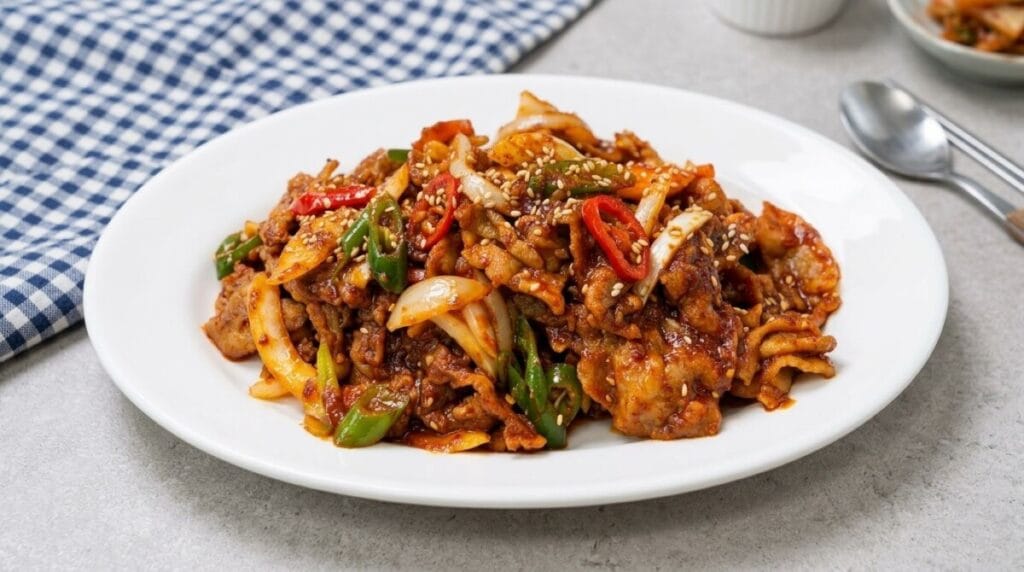
Spicy & Sweet Korean Stir-Fried Pork in Gochujang Sauce
Jeyuk Bokkeum is one of the most beloved staples on the Korean table — a bold, fiery stir-fry of thinly sliced pork tossed with vegetables in a gochujang-and-gochugaru marinade. The moment the pork hits a screaming-hot pan, a cloud of sweet, spicy aroma fills the kitchen, and within minutes you have a dish that is deeply savory, a little sticky, and completely addictive over a bowl of steamed white rice.
This recipe is built for the home cook who wants restaurant-level flavor without any complicated technique. From prepping the ingredients to nailing the final high-heat sear, every step is laid out clearly so that even first-timers can pull it off with confidence.
Jeyuk Bokkeum Ingredients
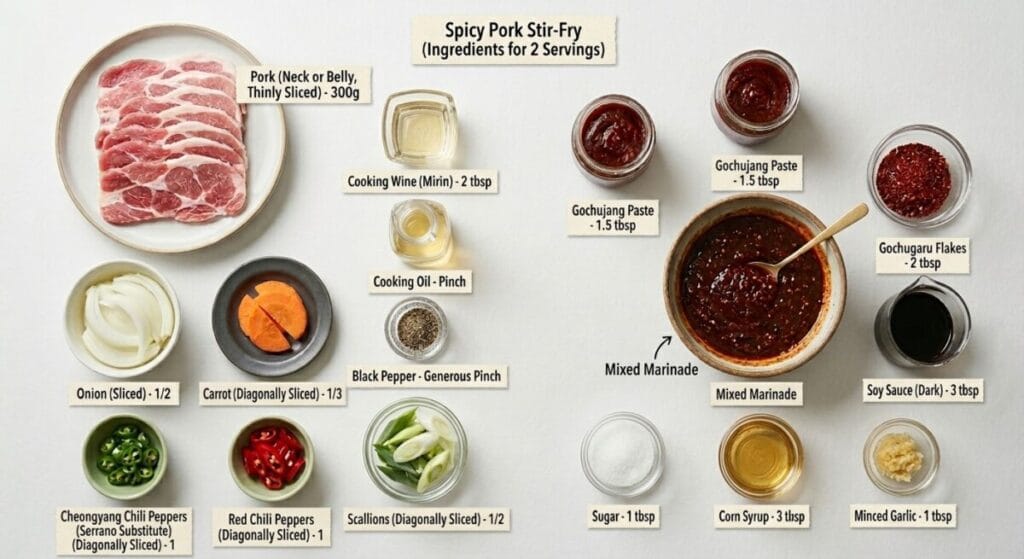
Main Ingredients(Serves 2)
| Ingredient | Amount |
|---|---|
| Pork shoulder or pork belly, thinly sliced | 300 g (10.5 oz) |
| Onion | ½ |
| Carrot | ⅓ |
| Cheongyang chili pepper (hot green chili) | 1 |
| Red chili pepper | 1 |
| Green onion (large stalk) | ½ |
| Mirin (rice wine) | 2 tbsp |
| Black pepper | generously |
| Cooking oil | as needed |
Marinade Sauce
| Ingredient | Amount |
|---|---|
| Gochujang (Korean red pepper paste) | 1.5 tbsp |
| Gochugaru (Korean red pepper flakes) | 2 tbsp |
| Soy sauce (dark / jin-ganjang) | 3 tbsp |
| Sugar | 1 tbsp |
| Oligosaccharide syrup (or corn syrup / honey) | 3 tbsp |
| Minced garlic | 1 tbsp |
How to Make Jeyuk Bokkeum — Step-by-Step
Step 1 — Prep Your Ingredients
- Pat the pork dry with paper towels to remove excess moisture, then cut into bite-sized pieces.
- Slice the onion into thick strips and cut the carrot into thin half-moons.
- Slice the cheongyang and red chili peppers on the diagonal, and cut the green onion into ½-inch (1.5 cm) pieces.
Step 2 — Make the Marinade and Marinate the Pork
- Combine gochujang, gochugaru, soy sauce, sugar, oligosaccharide syrup, minced garlic, mirin, and black pepper in a bowl. Mix until fully blended.
- Coat the pork with about two-thirds of the marinade, toss well, and refrigerate for at least 30 minutes. Marinating overnight gives the deepest flavor.
💡 Tip: Always marinate the pork separately before adding the vegetables. Adding veggies too early draws out moisture and makes them soggy before they even hit the pan.
Step 3 — Stir-Fry and Finish
- Heat a large skillet or wok over high heat with a drizzle of oil. Add the marinated pork and sear until the outside is sealed and lightly caramelized.
- Add the carrot first and stir-fry together for about 1 minute, then add the onion, cheongyang chili, and red chili.
- Pour in the remaining marinade and add the green onion. Stir-fry on high heat until the sauce reduces, clings to everything, and develops a glossy sheen.
💡 Tip: Crank the heat up high at the end — this caramelizes the sauce and gives it that irresistible sticky glaze. For a fun twist, top with shredded mozzarella, cover the pan, and let it melt for 30 seconds.
Must-Have vs. Substitutable Ingredients
Essential Ingredients — Don’t Skip These
| Ingredient | Why It Matters |
|---|---|
| Pork | The core protein — the dish is literally named after it |
| Gochujang | Base of the sauce; adds depth, heat, and umami |
| Gochugaru | Delivers the signature red color and extra kick |
| Soy sauce | Brings savory, salty depth to the marinade |
| Minced garlic | The aromatic backbone of the entire dish |
Flexible Ingredients — Easy Swaps
| Ingredient | Substitute / Note |
|---|---|
| Cheongyang chili pepper | Skip or swap for regular green chili to reduce heat |
| Red chili pepper | Mainly for color — ¼ red bell pepper works fine |
| Oligosaccharide syrup | Replace with corn syrup or honey at the same amount |
| Mirin | Sub with dry sherry, sake, or 1 tbsp of soju |
| Carrot | Optional — adds texture, but can be omitted entirely |
What to Serve with Jeyuk Bokkeum
The Classic Setup
Steamed white rice is the timeless pairing. Add a plate of fresh ssam vegetables — lettuce and perilla leaves — to wrap the spicy pork in, and you have a complete, satisfying Korean spread.
Recommended Side Dishes
| Side Dish | Why It Works |
|---|---|
| Ssam vegetables (lettuce, perilla) | Cool, fresh wraps that balance the heat |
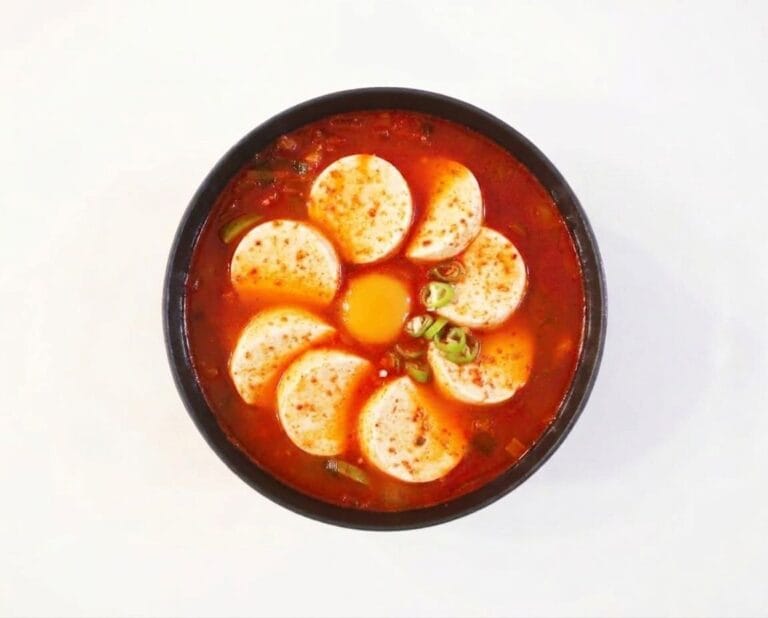
| Doenjang jjigae (soybean paste stew) | Earthy, savory depth that contrasts the spice |
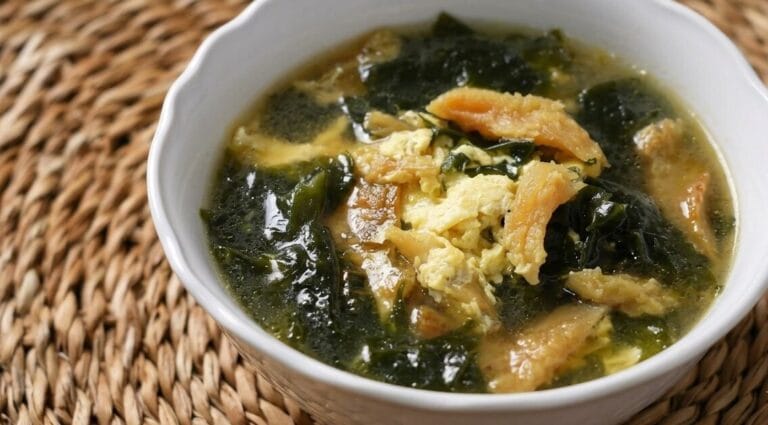
| Egg drop soup (gyeran-guk) | Mild and silky — a palate cleanser between bites |
| Kkakdugi or baechu kimchi | Tangy fermented crunch that cuts through the richness |
#jeyukbokkeum#제육볶음#koreanpork#koreanrecipe#gochujang#spicypork#koreanfood#stirfry#easydinner#asiancooking Copyright © 2026 First Korean Food. All rights reserved.
Nobody in Korea gets excited and announces “we’re having jeyuk-bokkeum tonight” the way they might with samgyeopsal or dak-galbi. It just kind of… shows up. On a Tuesday. At the office cafeteria. At the 백반집 down the street that’s been serving the same six side dishes since before you were born. It’s not a dish people plan around. It’s a dish that’s just always there.
And honestly, that’s the whole story with jeyuk-bokkeum. It doesn’t need a backstory or a hometown festival. It’s the rice you eat when you’re not in the mood to think about what to order, the thing your mom made on a random Wednesday, the safe bet when a group can’t agree on anything else. Here’s how Koreans actually relate to it.
The Default Order, Not the Exciting One
If you ask a Korean to name their favorite food, jeyuk-bokkeum almost never comes up first. But ask what they ordered for lunch three days ago, and there’s a decent chance it’s the answer. That gap between “favorite” and “frequently eaten” tells you most of what you need to know. It’s comfort food in the truest sense — not flashy, not Instagram bait, just reliably good.
There’s also a kind of trust built into it. Walk into almost any 백반집 (home-style diner) in Korea, and jeyuk-bokkeum will be on the menu, usually for around 8,000–10,000 won, usually served with rice, a bowl of soup, and a small army of banchan you didn’t even order. You don’t need to read reviews first. You already know roughly what you’re getting.
It’s One of the Few Korean Dishes Made for Eating Alone
Most of Korea’s well-known grilled meat dishes — samgyeopsal, dak-galbi, galbi — are built around groups. Big shared pans, communal grilling, the whole social production. Jeyuk-bokkeum quietly breaks that pattern. It comes out as a single plate, scaled for one person, no negotiation with anyone else required. For office workers eating lunch solo, or anyone who just wants a proper hot meal without organizing a group outing, that matters more than people give it credit for.
The Unspoken “Mom Test”
Here’s something that comes up constantly when Koreans talk about jeyuk-bokkeum: almost everyone compares it to their mother’s version, whether they mean to or not. It’s one of those dishes most people grew up eating at home, made with whatever cut of pork was on sale, however much gochujang felt right that day. So when they order it at a restaurant, there’s this automatic internal scorecard running — too sweet, not spicy enough, missing the char their mom always got on it.
This is partly why jeyuk-bokkeum rarely becomes a restaurant’s signature dish the way, say, a specific noodle shop becomes known for its noodles. It’s hard to “win” at a dish where everyone already has a deeply personal benchmark sitting in their memory.
Pork’s Workhorse, Standing Next to Its Flashier Cousins
Put jeyuk-bokkeum next to samgyeopsal and the contrast says a lot. Samgyeopsal is the dish people go out for — the grill at the table, the soju, the whole event of it. Jeyuk-bokkeum is what you eat when there’s no event happening at all, just hunger and a lunch break. Same animal, same general spice profile in some versions, completely different role in daily life.
That’s not a knock against it. If anything, Koreans tend to see this as a strength. Jeyuk-bokkeum doesn’t have to earn its place at the table through ceremony. It earns it through sheer repetition — through being good enough, often enough, that nobody questions ordering it again.
Wrapped in Lettuce, Eaten Without Ceremony
One small ritual that does survive with jeyuk-bokkeum: the ssam. Take a piece of lettuce or perilla leaf, add a spoonful of the pork, a dab of ssamjang, maybe a sliver of raw garlic, and wrap it up. It’s not unique to this dish, but it’s how a lot of Koreans instinctively eat it, almost without thinking. There’s a quiet pleasure in that — a dish humble enough for an everyday lunch, but still built with enough texture and ritual to feel like a real meal rather than just fuel.
Why It Doesn’t Need to Be Famous
Jeyuk-bokkeum will probably never get its own tourism campaign the way dak-galbi got Chuncheon, or samgyeopsal got its own cultural mythology around Korean barbecue night. And most Koreans wouldn’t really want that for it. Part of its identity is being unbothered by hype — the dish that’s good without trying to be impressive, that feeds people without asking for attention in return.
For visitors, that’s actually a useful thing to know. If you want a meal that shows you how Koreans eat on an ordinary day — not a special-occasion day, not a tourist day, just a regular Tuesday — order jeyuk-bokkeum at a neighborhood 백반집. It won’t be the most memorable photo of your trip. But it might be the most honest one.