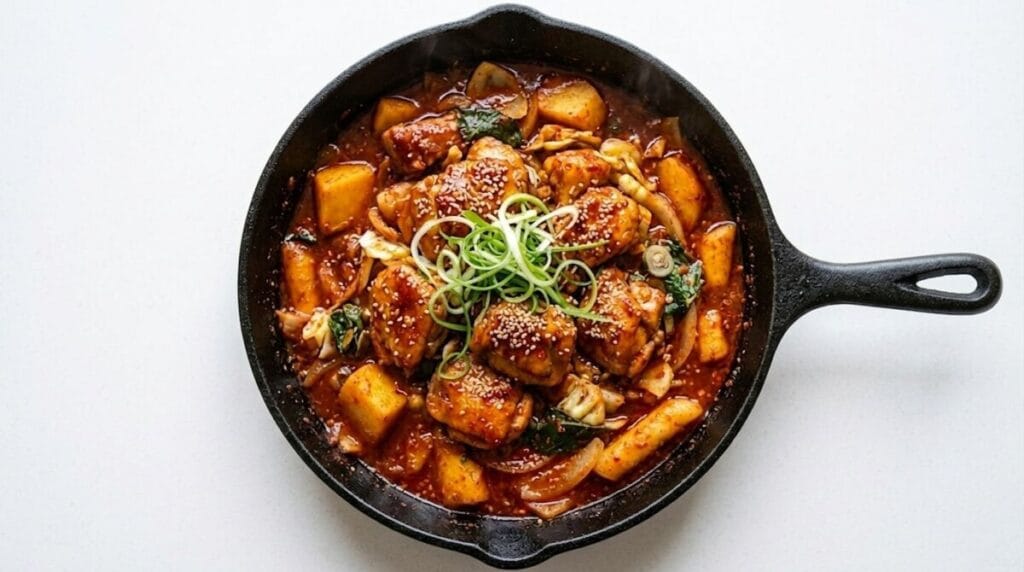
On the menu today is stir-frying chicken in a spicy gochujang sauce
Dakgalbi Ingredients
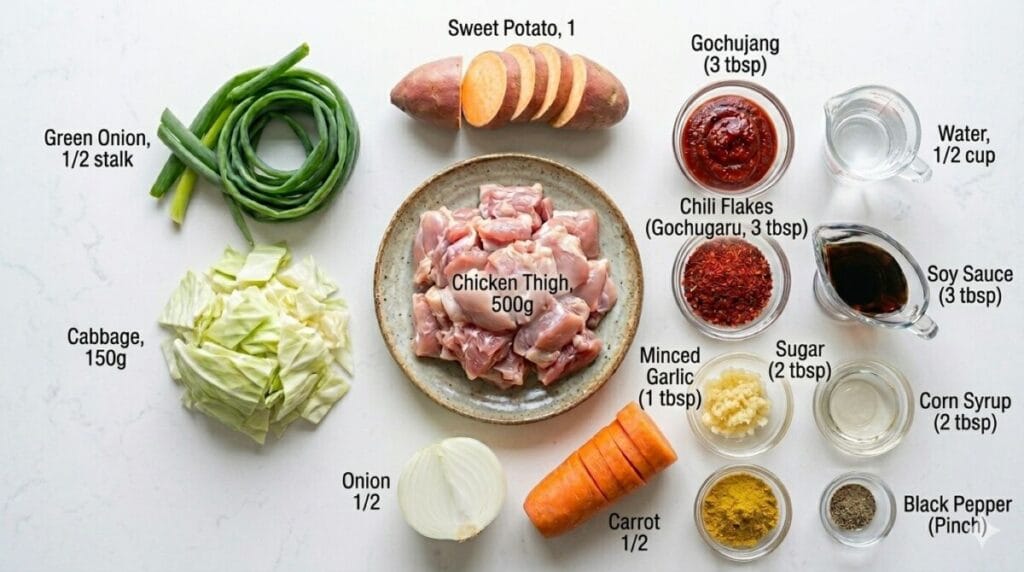
Main ingredients(Serves 2)
Chicken Thighs (Boneless) – 500g
Sweet Potato – 1 medium-sized
Cabbage – 150g
Onion – 1/2
Carrot – 1/2
Green Onion – 1/2 stalk
Water – 1/2 cup
Marinade sauce
Gochujang (Korean chili paste) – 3 tbsp
Gochugaru (Korean chili powder) – 3 tbsp
Soy Sauce – 3 tbsp
Sugar – 2 tbsp
Corn Syrup (or Honey) – 2 tbsp
Mirin (Cooking wine) – 2 tbsp
Minced Garlic – 1 tbsp
Curry Powder – 1 tbsp
Black Pepper – A pinch
How to Make Dakgalbi — Step-by-Step
Step 1 — Prep your ingredients and sauce
- Cut chicken thighs into bite-sized pieces, rinse briefly under cold water, and pat dry.
- Slice sweet potato and carrot into ½-inch half-moons. Tear cabbage into large pieces. Thinly slice the onion.
- Combine all marinade ingredients in a bowl and mix well until fully blended.
Step 2 — Marinate the chicken
- Coat the chicken with about two-thirds of the marinade and toss to combine. Refrigerate for at least 30 minutes — overnight gives the best flavor.
Tip: Marinate the chicken separately first and add the vegetables only when cooking. This keeps the veggies from getting soggy.
Step 3 — Stir-fry and serve
- Heat a large skillet or wok over medium-high heat with a drizzle of oil. Add the marinated chicken and cook until the outside is sealed and lightly caramelized.
- Add carrot and sweet potato, pour in ½ cup of water, cover with a lid, and steam-cook for about 5 minutes.
- Add cabbage, onion, green onion, and the remaining marinade. Stir-fry on high heat until the liquid evaporates and the sauce clings to everything.
Tip: For the perfect finish, turn up the heat slightly at the end. This caramelizes the sauce, locking in that deep, smoky flavor. If you want to take it to the next level, sprinkle a generous amount of shredded mozzarella on top and let it melt into a gooey, cheesy heaven right in the pan.”
Don’t Forget the Grand Finale! (Pro Tip)
Here is the golden rule of Dakgalbi: Never finish all the sauce.
When you have just a few bites of chicken and vegetables left, it’s time for the “K-Dessert”—Fried Rice (Bokkeumbap).
- Add a bowl of steamed rice, seaweed flakes, and a drizzle of aromatic sesame oil into the leftover sauce.
- Press it down against the hot pan until the bottom gets delightfully crispy.
- Optional but Highly Recommended: Add a mountain of mozzarella cheese in the middle for a “cheese lava” effect.
One bite of this crispy, cheesy rice, and you’ll understand why Dakgalbi is a favorite comfort food for millions in Korea.
Must-Have vs. Optional Ingredients
Essential ingredients must have
These are the core ingredients that define the flavor of dakgalbi. As long as you have these, you’re good to go.
| Ingredient | Why it matters |
|---|---|
| Boneless chicken thighs | Core protein — cannot skip |
| Gochujang | Base of the sauce |
| Gochugaru | Adds heat and color |
| Soy sauce | Adds savory depth |
| Minced garlic | Essential aroma |
| Cabbage | Classic dakgalbi vegetable |
| Sugar or corn syrup | Balances the spice |
Optional ingredients flexible
These add flavor and texture, but can be skipped or swapped based on what you have on hand.
| Ingredient | Substitute / Note |
|---|---|
| Sweet potato | Sub with potato or rice cakes |
| Carrot | Can skip entirely |
| Green onion | Sub with scallions |
| Curry powder | Optional — skip if needed |
| Mirin | Sub with dry sherry or sake |
| Corn syrup | Sub with extra sugar |
#dakgalbi#koreanchicken#koreanrecipe#spicychicken#gochujang#koreanfood#easydinner#asiancooking
Ask any Korean what dak-galbi means to them, and you’ll rarely get a simple answer about food. You’ll get a memory instead — a college trip to Chuncheon with friends, a rainy Tuesday night with coworkers, the specific sound of chicken and rice cake sizzling on a giant iron pan while someone pours the soju. Dak-galbi isn’t just eaten in Korea. It’s remembered.
For a dish that started as a cheap way to stretch a small amount of meat in the 1960s, dak-galbi has had a remarkable journey. Today it sits in an interesting spot in Korea’s food culture — beloved, a little nostalgic, occasionally underestimated, and still one of the most ordered dishes in the country. Here’s how Koreans actually think about it.
Born from Necessity, Not Luxury
Dak-galbi’s origin story matters a lot to how Koreans see it. The dish traces back to Chuncheon, Gangwon Province, in the 1960s, when pork was expensive and chicken was the affordable substitute. Small eateries near the city’s market would marinate chicken in a spicy gochujang-based sauce and stretch it with cabbage, sweet potato, and rice cake to feed more people for less money.
That history gives dak-galbi a kind of working-class authenticity that Koreans respect. It isn’t a royal court dish or something with a polished, prestigious backstory — it’s food that came from real economic hardship and real ingenuity. Older Koreans in particular tend to view it through that lens: a humble dish that earned its popularity rather than one that was marketed into it.
Chuncheon Still Owns the Dish
Even decades later and with dak-galbi restaurants on nearly every street in Seoul, most Koreans still mentally file the “real” version under Chuncheon. There’s a strong cultural sense that you haven’t truly had dak-galbi until you’ve eaten it there, ideally after a short train or bus ride out of the city. The Chuncheon Dak-galbi Festival reinforces this every year, drawing the dish back to its roots as a point of regional pride rather than just a generic Korean BBQ-style meal.
Less a Meal, More a Social Event
If you ask Koreans when they eat dak-galbi, almost nobody says “alone.” It’s a dish built for groups — the giant shared pan, the communal stirring, the ritual of waiting for the rice or noodles to be added at the end once the meat is gone. Eating it solo at a counter just isn’t really part of how it’s used.
A Staple of Hoesik and Friend Gatherings
Dak-galbi shows up constantly at company dinners (회식), college club gatherings, and reunions with old friends. Part of the appeal is practical — it’s filling, affordable per person, and pairs naturally with soju and beer. But part of it is emotional: the format of the dish, cooked together at the table over a long stretch of time, fits naturally into Korean dining culture’s emphasis on shared experience over individual plating.
The Bokkeumbap Finale
Ask any Korean about their favorite part of a dak-galbi meal, and a huge number will say the fried rice at the end, not the chicken itself. Cooking rice in the leftover sauce, cheese, and bits of chicken is treated almost as the true climax of the meal — to the point where some people order dak-galbi mainly to get to that final stage.
A Generational Divide in How It’s Viewed
Interestingly, dak-galbi doesn’t sit the same way across age groups. Older Koreans tend to associate it with simpler times — cheap, hearty food from their youth, sometimes mentioned in the same breath as army-base stew (budae-jjigae) as a product of leaner economic decades.
Younger Koreans, on the other hand, mostly experience dak-galbi as comfort food for student life: cheap enough for a tight budget, filling enough to justify the price, and social enough to be the default choice for group hangouts near universities. It rarely shows up on a “fancy date” list, but it almost always shows up on a “what should we eat tonight” group chat.
Casual, Not Prestigious — and Koreans Are Fine With That
In Korea’s internal food hierarchy, dak-galbi sits firmly in the “comfort food” tier rather than the “special occasion” tier. It won’t appear in a Michelin guide, and nobody is taking a first date there to impress them. But this isn’t a knock against the dish — Koreans are generally very comfortable with food existing purely to be satisfying and fun rather than impressive. Dak-galbi’s lack of pretension is part of its charm, not a flaw.
Quietly Becoming a K-Food Ambassador
What has shifted in recent years is how Koreans see dak-galbi’s role abroad. With the broader K-food wave, many Koreans have noticed international visitors actively seeking out dak-galbi as a “must-try” dish — something that surprises a lot of locals who grew up thinking of it as everyday food rather than a cultural export.
There’s a mild sense of pride in this. Koreans often describe dak-galbi as an easier entry point into Korean food for international visitors than something like raw fermented dishes — spicy but approachable, chicken-based and familiar, interactive and fun to cook at the table. It’s increasingly seen as a dish that represents Korea well without needing to be explained too much.
The Bottom Line
To Koreans, dak-galbi isn’t really about the chicken. It’s about who you’re eating it with, the noise of the pan, the inevitable rice at the end, and the memory of wherever you happened to be sitting when you ate it. It’s humble, it’s social, and it’s stayed remarkably consistent in what it means to people — even as the rest of the world has started discovering it for the first time.