Why Korean Cuisine Is Unique: Fermentation, Seasonal Foods, and Tradition
Korean cuisine is more than a collection of recipes. It reflects the country’s changing seasons, regional landscapes, food preservation traditions, and the everyday habits of people who have prepared and shared meals for generations.
A traditional Korean meal may include rice, soup, kimchi, seasoned vegetables, and several side dishes. These foods are not necessarily served in the same combination every day. The ingredients and cooking methods vary according to the household, region, season, and type of meal.
For international visitors, understanding these traditions can make Korean food easier to appreciate. A bowl of kimchi jjigae, a plate of bibimbap, or a table filled with small side dishes becomes more interesting when you understand the cultural ideas behind the ingredients and preparation methods.
This guide explores six important aspects of Korean cuisine: traditional food colors, fermentation, seasonal eating, regional specialties, royal court cuisine, and the customs that shape a Korean meal.
1. The Meaning of Color in Traditional Korean Cuisine
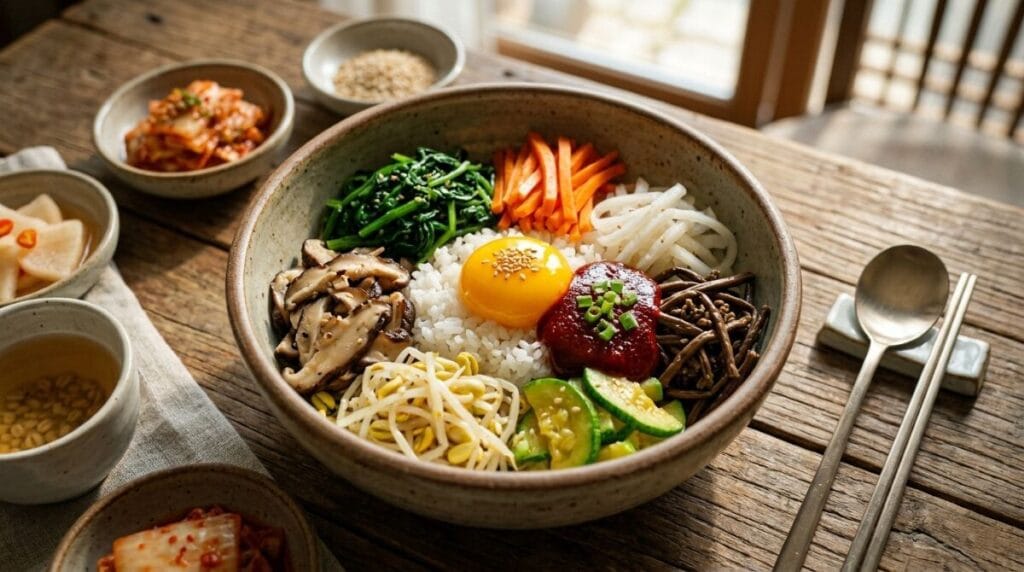
One of the first things people notice about Korean food is its variety of colors. A bowl of bibimbap, for example, may contain white rice, green vegetables, orange carrots, yellow egg, and dark seasoned ingredients. The colors make the dish visually appealing, but they also reflect the variety of ingredients used in Korean cooking.
Traditional Korean culture includes the concept of obangsaek, a system of five symbolic colors associated with traditional cosmology and the five directions. The colors are white, black, blue or green, red, and yellow. These colors also have connections to traditional interpretations of the five elements.
The concept appears in Korean decorative arts, ceremonial foods, and certain traditional dishes. However, it is important to understand that obangsaek is a cultural and symbolic system rather than a rule that every Korean meal must contain five colors.
Bibimbap: A Practical Example of Color and Variety
Bibimbap is one of the clearest examples of how different ingredients can come together in a single Korean dish.
A typical bowl contains rice topped with seasoned vegetables, sometimes meat, an egg, and gochujang, a fermented red chili paste. Ingredients vary depending on the recipe and region.
The vegetables contribute different textures and flavors. Some are crunchy, others are tender, and their seasonings may include garlic, sesame oil, soy sauce, or salt.
Before eating, diners usually mix the ingredients together. The result is a combination of rice, vegetables, seasoning, and other toppings rather than a dish in which each ingredient is eaten separately.
Bibimbap is a useful introduction to Korean cuisine because it demonstrates how one meal can combine multiple ingredients without requiring several separate dishes.
Gujeolpan and Traditional Food Presentation
Another example is gujeolpan, a traditional dish in which different ingredients are arranged in separate sections around a central compartment of thin wheat pancakes.
The ingredients may include vegetables, mushrooms, and meat, depending on the preparation. Diners place selected fillings inside a pancake and eat them together.
Gujeolpan demonstrates the attention that some Korean dishes give to presentation, variety, and the combination of ingredients.
Not every Korean dish follows these elaborate arrangements. Everyday meals are often much simpler, but traditional dishes such as gujeolpan show how color and presentation can become important parts of the dining experience.
2. Fermentation: The Foundation of Many Korean Flavors
Fermentation is one of the defining characteristics of Korean cuisine. It helps explain the distinctive flavors of kimchi, doenjang, gochujang, and ganjang.
Historically, preserving food was important in a country with pronounced seasonal changes. Fermented foods and sauces allowed ingredients to be stored and used over time, while fermentation also created complex flavors that could not be produced through ordinary cooking alone.
Today, these foods remain important in both traditional home cooking and modern Korean restaurants.
Kimchi: More Than a Side Dish
Kimchi is a broad category of fermented vegetables rather than a single recipe.
The best-known variety is made with napa cabbage, radish, salt, garlic, ginger, chili pepper, and other seasonings. However, Korean cuisine includes many varieties made with different vegetables and preparation methods.
Kimchi’s flavor changes as fermentation progresses. Depending on the ingredients, temperature, salt concentration, and fermentation time, it may taste relatively fresh and crisp or become more sour and pronounced.
These changes also influence how kimchi is used in cooking.
Freshly prepared or less sour kimchi can be served as a side dish. More mature kimchi is often used in dishes such as kimchi jjigae, kimchi fried rice, and kimchi pancakes.
Kimchi is commonly served with rice and other dishes, but it is not limited to traditional meals. It can also appear in contemporary Korean fusion food.
For visitors trying Korean food for the first time, one useful point is that not every type of kimchi has the same level of spiciness or sourness.
Doenjang: The Savory Taste of Fermented Soybeans
Doenjang is a traditional Korean soybean paste with a deep, savory flavor.
It is made through a fermentation process involving soybeans. Traditional production methods can vary, and the final flavor depends on factors such as ingredients, fermentation conditions, and aging.
Doenjang is widely used in Korean home cooking.
One familiar example is doenjang jjigae, a soybean paste stew that may contain tofu, zucchini, potatoes, onions, mushrooms, or other ingredients.
Doenjang can also be used in sauces and marinades. Its flavor is different from that of ordinary soy sauce because it has a thicker texture and a concentrated soybean taste.
For international visitors, doenjang jjigae is a good dish to try when exploring savory Korean stews beyond the more familiar spicy options.
Gochujang: Sweet, Spicy, and Savory
Gochujang is a fermented Korean chili paste known for its combination of heat, sweetness, saltiness, and savory depth.
It is commonly used in bibimbap, tteokbokki, marinades, and dipping sauces. The exact flavor varies by product and recipe.
Although gochujang is strongly associated with Korean spicy food, it is not the only seasoning used in Korean cooking. Many dishes rely on soy sauce, sesame oil, garlic, fermented soybean paste, or other ingredients instead.
Travelers who avoid spicy food should not assume that every Korean dish contains gochujang. Asking about the seasoning before ordering is a practical way to choose a meal that suits individual preferences.
Ganjang: A Versatile Korean Soy Sauce
Ganjang is Korean soy sauce. It is used to season soups, vegetables, marinades, dipping sauces, and many other dishes.
Different types of Korean soy sauce have different production methods and culinary uses. Traditional soup soy sauce, for example, is commonly associated with seasoning soups and is generally saltier than some soy sauces used for other purposes.
Together, kimchi, doenjang, gochujang, and ganjang demonstrate how fermentation contributes to the variety of Korean flavors.
These foods are important cultural ingredients, but their presence does not mean every Korean meal tastes fermented or strongly seasoned. Korean cuisine also includes mild soups, steamed foods, grilled dishes, fresh vegetables, and simple rice-based meals.
3. Seasonal Eating and the Korean Food Calendar
Korea experiences four distinct seasons, and seasonal changes have influenced the country’s food culture for generations.
Historically, people relied on ingredients available at different times of the year. Preserving vegetables, preparing fermented sauces, and making use of local agricultural products helped households adapt to seasonal conditions.
Modern transportation and food distribution have made many ingredients available throughout the year. Nevertheless, seasonal foods and traditional food customs remain part of Korean dining culture.
Spring: Fresh Greens and Seasonal Vegetables
Spring is associated with a variety of young greens and wild vegetables, including shepherd’s purse and other edible plants.
These ingredients are used in soups, seasoned vegetable dishes, and other preparations. Their flavors can range from mild and fresh to distinctly earthy or slightly bitter.
Namul refers to a broad category of Korean vegetable dishes that may be seasoned with ingredients such as garlic, sesame oil, soy sauce, salt, or sesame seeds.
Spring vegetables are particularly useful for understanding the variety of textures and seasonings found in Korean side dishes.
Availability varies by region and year, so not every seasonal vegetable appears on every restaurant menu.
Summer: Samgyetang and the Tradition of Bogyangsik
Samgyetang is a Korean chicken soup traditionally prepared with a young chicken, glutinous rice, garlic, jujubes, and ginseng or other ingredients, depending on the recipe.
It is especially associated with boknal, traditional summer days connected to the hottest period of the year.
During these occasions, many Koreans eat samgyetang as a form of bogyangsik, a term commonly used for foods traditionally consumed to support strength and well-being.
The cultural significance of samgyetang is important, but traditional beliefs about seasonal nourishment should not be confused with proven medical effects. Eating hot soup does not automatically prevent heat-related illness or restore lost energy.
From a visitor’s perspective, samgyetang is a useful dish to try when exploring Korean food traditions beyond barbecue and street food.
Autumn: Harvest Ingredients and Hearty Meals
Autumn is traditionally associated with the harvest of rice, grains, fruits, and other agricultural products.
Depending on the region and season, Korean meals may feature ingredients such as mushrooms, sweet potatoes, chestnuts, pears, and other produce.
These ingredients appear in soups, rice dishes, porridges, desserts, and side dishes.
The connection between autumn and harvest is not unique to Korea, but it helps explain why seasonal ingredients have an important place in traditional Korean food culture.
Winter: Kimchi, Preserved Foods, and Warm Soups
Winter provides one of the clearest examples of how seasonal conditions shaped Korean cuisine.
Before modern refrigeration became widespread, preserving vegetables and other ingredients was an important part of household food preparation.
Kimjang, the traditional practice of preparing kimchi for the colder months, became a significant part of Korean food culture. Families and communities often worked together to prepare large quantities of kimchi.
Kimjang is more than a food preparation method. It also reflects traditions of cooperation, sharing, and passing knowledge between generations.
Winter meals may also include warm soups, stews, porridges, and dishes made with preserved ingredients.
Today, people do not necessarily prepare all their own kimchi, and household practices differ. However, kimjang remains a recognizable example of the relationship between food, seasonal preparation, and community life in Korea.
4. Regional Korean Cuisine: Why Food Changes Across the Country
Korean cuisine is not uniform throughout the country.
Regional differences reflect geography, local ingredients, agricultural traditions, climate, and historical patterns of trade and settlement.
Coastal areas have access to a wide range of seafood, while mountainous regions have traditions involving locally available vegetables, grains, and other ingredients. Agricultural regions have developed their own preparations using rice, vegetables, and locally produced foods.
These are broad patterns rather than strict rules. Modern restaurants, migration, and nationwide food distribution mean that many regional dishes are now available far from where they originated.
Jeonju and the Food Culture of Jeollabuk-do
Jeonju, in the Jeolla region, is widely associated with bibimbap and a rich food culture.
Jeonju-style bibimbap is known for its variety of ingredients and careful preparation, although recipes differ between restaurants and households.
The wider Jeolla region is also associated with diverse side dishes and generous meal presentations in many traditional dining settings.
For travelers, trying a regional specialty in the place associated with it can provide useful cultural context. However, the quality and style of a dish depend on the individual restaurant, not just its location.
Gangwon-do: Mountain Ingredients and Buckwheat
Gangwon-do includes extensive mountainous areas, and its food traditions reflect the ingredients available in those environments.
Buckwheat is used in dishes such as makguksu, a regional noodle dish commonly associated with Gangwon-do.
Potatoes and other locally grown ingredients also appear in regional preparations.
These foods demonstrate that Korean cuisine extends well beyond rice, meat, and chili-based dishes. Grains, roots, vegetables, and noodles are also important parts of the country’s culinary traditions.
Busan and Coastal Seafood
Busan is a major coastal city with a strong association with seafood.
Fish, shellfish, and other marine ingredients feature prominently in many local restaurants and markets.
One well-known regional dish is dwaeji gukbap, a pork soup served with rice. Although Busan is strongly associated with seafood, its local food culture includes many dishes that do not rely on fish.
Visitors exploring Busan can therefore experience both coastal ingredients and hearty soup-based meals.
Korean Cuisine Also Reflects Modern History
Not every Korean dish developed from ancient traditions.
Budae jjigae, commonly translated as army base stew, is associated with the period after the Korean War and the use of ingredients that became available around U.S. military installations.
Modern versions often include sausage, ham, kimchi, tofu, noodles, and a spicy broth, although ingredients vary by restaurant.
Budae jjigae illustrates how Korean food continues to evolve through historical circumstances, new ingredients, and changing tastes.
It is a useful reminder that Korean cuisine is not a fixed collection of old recipes. It has continually adapted to social and economic changes.
5. Royal Court Cuisine and Everyday Korean Meals
Korean food culture includes both elaborate dishes associated with the royal court and simple meals prepared in ordinary households.
Royal court cuisine developed within the historical setting of the Korean monarchy. Its presentation and preparation could involve carefully arranged ingredients, specialized cooking techniques, and multiple dishes.
However, royal court food should not be treated as a complete representation of what ordinary Koreans ate throughout history.
Everyday meals have varied according to household resources, region, season, and historical period.
What Is Different About Royal Court Cuisine?
Traditional royal court meals could include a range of rice dishes, soups, stews, vegetables, meats, and other preparations.
Some dishes emphasize careful knife work, balanced presentation, and the combination of different ingredients.
Gujeolpan is one example of a traditional dish associated with elaborate food presentation. Its separate compartments hold different ingredients that diners combine according to their preferences.
These preparations can be interesting to explore, but they are not necessarily representative of everyday Korean dining.
Visitors who want to try traditional Korean food can look for restaurants specializing in court-style cuisine or traditional multi-course meals. Prices, portion sizes, and menu formats vary, so checking the menu before visiting is advisable.
What Does an Everyday Korean Meal Look Like?
A common Korean meal includes rice, soup or stew, kimchi, and one or more side dishes called banchan.
This arrangement is often described as baekban, a familiar style of everyday Korean meal.
The exact combination depends on the restaurant and household. A simple meal may contain only a few components, while a larger meal can include several side dishes and a main dish.
Banchan may include seasoned vegetables, kimchi, braised ingredients, pancakes, or other preparations.
In many Korean restaurants, some side dishes are provided with the main meal and may be refillable, although this is not guaranteed. Restaurant policies differ, so visitors should check with the staff if they would like more.
The important point is that Korean dining is not defined by the number of dishes on the table. The combination of rice, shared side dishes, soups, and main dishes offers different ways to enjoy ingredients together.
6. How to Order Korean Food as a First-Time Visitor
Understanding Korean food traditions can make choosing a restaurant easier, particularly if you are unfamiliar with the ingredients or seasoning styles.
Here are a few practical starting points.
If You Prefer Mild Flavors
Bulgogi is a useful introduction to Korean food. It is commonly made with thinly sliced beef marinated in a mixture that may include soy sauce, sugar, garlic, and sesame oil.
The flavor is usually savory and slightly sweet rather than chili-hot, although recipes differ.
Gomtang and seolleongtang are other options for visitors interested in warm, relatively mild soups. Their flavor profiles vary, and diners may season them at the table.
If You Want to Try Traditional Fermented Flavors
Try kimchi, doenjang jjigae, or dishes seasoned with ganjang.
These foods offer different examples of fermentation in Korean cooking. Kimchi is usually a vegetable side dish, doenjang jjigae is a soybean paste stew, and ganjang is used as a seasoning in many recipes.
Their flavors are distinct, so trying them separately can help you understand how fermented ingredients contribute to Korean food.
If You Enjoy Spicy Food
Tteokbokki, kimchi jjigae, and some versions of bibimbap are popular options.
Tteokbokki is made with chewy rice cakes and a sauce that often contains gochujang. The level of heat varies considerably.
Kimchi jjigae is a stew commonly prepared with kimchi and may include tofu, pork, or other ingredients.
Bibimbap may be served with gochujang separately or added to the bowl, depending on the restaurant. If you prefer less heat, ask whether the sauce can be served on the side.
If You Are Vegetarian
Do not assume that a dish is vegetarian simply because it contains vegetables.
Some vegetable dishes are seasoned with fish sauce, salted seafood, meat-based stock, or other animal-derived ingredients. Kimchi recipes can also include seafood-based seasonings.
If you follow a vegetarian diet, explain your dietary requirements clearly and ask about the ingredients.
Useful questions include whether the soup contains meat stock, whether a vegetable dish includes fish sauce, and whether kimchi contains seafood.
If you follow a strict vegan diet, it is especially important to check sauces, broths, and side dishes rather than judging by appearance alone.
If You Have Food Allergies
Ask about ingredients and possible cross-contact before ordering.
Soybeans, wheat, sesame, shellfish, and fish appear in many Korean dishes and sauces. Recipes vary, and a dish’s name alone may not reveal every ingredient.
For a serious allergy, communicate the specific allergen clearly and confirm whether the restaurant can safely accommodate your needs.
These practical considerations are part of understanding Korean food as it is actually served, rather than only learning about its history.
7. Yaksik Dongwon: The Traditional Connection Between Food and Well-Being
The Korean expression yaksik dongwon is often translated as the idea that food and medicine share a common source.
It reflects a traditional perspective in which food, daily habits, and well-being are closely connected.
This idea can be seen in the cultural importance of ingredients such as garlic, ginger, ginseng, fermented soybean products, and various vegetables. These ingredients are used in many Korean dishes because of their flavors and established culinary roles.
The concept should not be interpreted as meaning that food can replace medical treatment or that a traditional dish necessarily provides a specific health benefit.
Korean cuisine includes a wide range of foods, cooking methods, and nutritional profiles. Its healthfulness depends on the ingredients, preparation methods, portion sizes, and overall eating pattern.
For example, a meal containing vegetables, rice, and a suitable protein source may offer a different nutritional profile from a meal dominated by salty preserved foods or heavily seasoned processed ingredients.
Rather than labeling all Korean food as healthy or unhealthy, it is more useful to consider the individual dishes and how they fit into an overall diet.
This approach allows traditional food culture to be appreciated without making unsupported medical claims.
8. What Makes Korean Cuisine Distinctive?
Korean cuisine has developed through the interaction of ingredients, geography, seasons, history, and everyday eating habits.
Fermented foods such as kimchi, doenjang, gochujang, and ganjang contribute distinctive flavors. Seasonal traditions reflect the importance of harvests and food preservation. Regional specialties demonstrate how local environments and historical experiences have shaped different dishes.
At the same time, everyday Korean meals show that this cuisine is not always elaborate. Rice, soup, kimchi, vegetables, and a main dish can form a simple meal, while traditional court-style cuisine offers a more elaborate dining experience.
For international visitors, learning about these differences makes it easier to explore Korean food with confidence.
You do not need to understand every historical tradition before trying your first Korean meal. Start with a dish that suits your preferences, ask about unfamiliar ingredients, and try different regional specialties when the opportunity arises.
The more you explore, the clearer it becomes that Korean cuisine is not defined by a single flavor or cooking method. Its character comes from the many ways ingredients, traditions, and people come together around the table.
Sources and Further Reading
The following resources provide additional information about Korean food culture, traditional ingredients, fermentation, and regional specialties.
- Korea Tourism Organization: About Korean Food — An introduction to Korean food culture, everyday meals, and regional diversity.
- Korea Tourism Organization: Traditional Korean Food — Background on traditional Korean dishes, including kimchi, bibimbap, and fermented seasonings.
- Korea Tourism Organization: Korean Food Story — Additional information about kimchi, regional food traditions, and the historical role of food preservation.
- Korea Tourism Organization: K-Local Food Trip 33 — Examples of regional Korean specialties and seasonal ingredients.
These sources offer starting points for readers who want to explore Korean cuisine beyond individual recipes.
Editorial note: This article is intended as a cultural introduction to Korean cuisine. Traditional customs and regional food practices vary among households, communities, and restaurants.