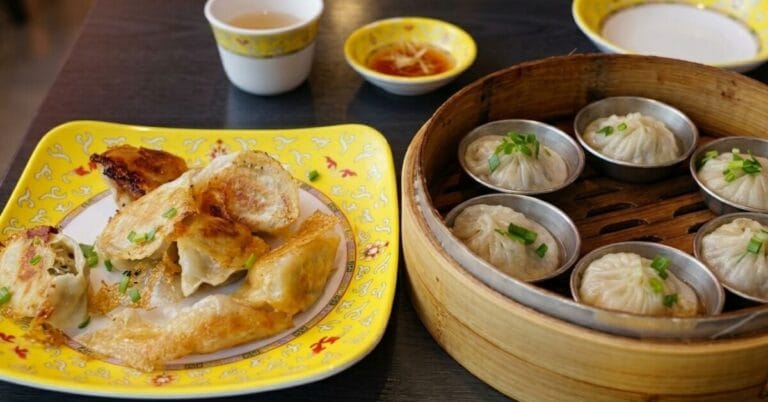
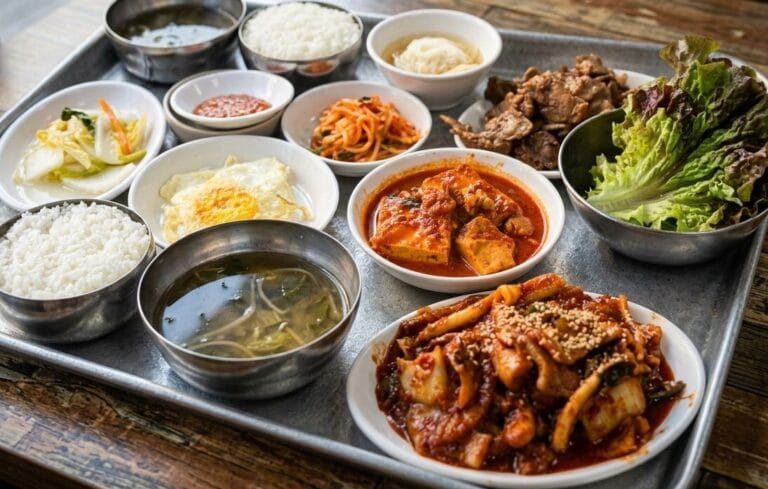
You can enjoy a bowl of Korean knife-cut noodles for ₩12,000 in Myeongdong, order a traditional Korean set meal for around ₩15,000, or share a plate of crispy Chinese-style pork with someone else.
Although Myeongdong is best known for shopping, cosmetics stores, and street food, its surrounding streets also contain established restaurants specializing in Korean comfort food and regional noodle dishes.
The challenge isn’t finding somewhere to eat. It’s deciding which restaurant suits your appetite, budget, and travel plans.
Some restaurants specialize in quick individual meals, while others offer larger dishes that are better shared.
This guide introduces five restaurants around Myeongdong, including Korean noodle shops, a traditional set-meal restaurant, a Chinese-style shaved noodle specialist, and two long-established Korean soup and cold noodle restaurants.
You’ll find representative menu prices, practical ordering advice, and recommendations based on different dining situations.
Price information: Menu prices were researched on October 17, 2026, using publicly available Korean restaurant listings. These are published reference prices, not guaranteed current in-store prices.
Quick Comparison: 5 Restaurants in Myeongdong
| Restaurant | Main Specialty | Example Price | Best For |
|---|---|---|---|
| Myeongdong Kyoja | Kalguksu and dumplings | ₩12,000 | First-time visitors |
| O’uga | Korean set meals and bulgogi | ₩11,000–₩20,000 | Traditional Korean dining |
| Lanju Kalmyeon | Knife-shaved noodles | ₩10,000–₩13,000 | Noodle lovers |
| Miseongok | Seolleongtang | ₩13,000 | Korean beef soup |
| Myeongdong Hamheung Myeonok | Cold noodles | ₩13,000–₩14,000 | Naengmyeon lovers |
These prices refer to selected menu items rather than the full price range at each restaurant.
If you’re visiting Korea for the first time, Myeongdong Kyoja is a straightforward introduction to Korean noodles and dumplings.
O’uga is worth considering if you want a rice-based meal with Korean side dishes.
Lanju Kalmyeon offers a different experience centered on Chinese-style knife-shaved noodles.
Miseongok specializes in seolleongtang, a traditional Korean beef soup, while Myeongdong Hamheung Myeonok focuses on cold noodles.
1. Myeongdong Kyoja (명동교자): Korean Knife-Cut Noodles and Dumplings
Best for: First-time visitors, solo travelers, and anyone interested in classic Korean noodle dishes.
Address: 29 Myeongdong 10-gil, Jung-gu, Seoul
Korean address: 서울 중구 명동10길 29
Nearest station: Myeongdong Station, Line 4
Why Is Myeongdong Kyoja So Well Known?
Myeongdong Kyoja is one of the area’s established Korean noodle restaurants.
Its menu focuses on a small selection of dishes, particularly kalguksu and mandu.
Unlike restaurants offering dozens of unrelated dishes, Myeongdong Kyoja concentrates on a few familiar Korean foods.
The restaurant has also received Michelin Bib Gourmand recognition.
Bib Gourmand is different from a Michelin star. It recognizes restaurants offering good-quality food at a reasonable price.
For travelers who want to experience Korean noodles without navigating an extensive menu, Myeongdong Kyoja is a practical choice.
Myeongdong Kyoja Menu and Prices
| Menu | Korean Name | Listed Price |
|---|---|---|
| Kalguksu | 칼국수 | ₩12,000 |
| Mandu | 만두 | ₩13,000 |
| Bibim Guksu | 비빔국수 | ₩12,000 |
| Kongguksu (Seasonal) | 콩국수 | ₩13,000 |
Prices are based on public menu listings. Kongguksu is a seasonal dish, generally available during warmer months.
What Should You Order?
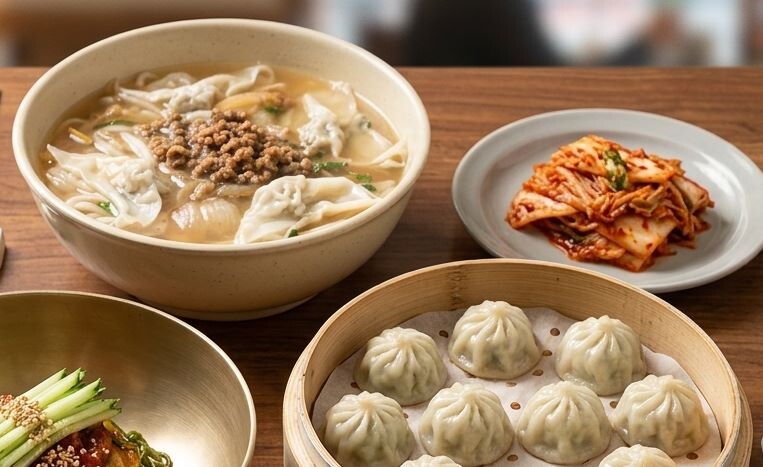
Kalguksu (칼국수) — ₩12,000
Kalguksu is a Korean noodle soup made with wheat noodles.
The name combines kal, meaning knife, and guksu, meaning noodles.
Traditionally, kalguksu noodles are made by rolling out dough and cutting it into strips.
Myeongdong Kyoja’s version is associated with a chicken-based broth, minced meat, and dumplings.
Unlike spicy Korean soups, the broth itself is generally savory rather than chili-heavy.
This makes kalguksu an approachable choice for travelers who prefer mild food.
However, the accompanying kimchi is known for its strong garlic flavor.
Mandu (만두) — ₩13,000
Mandu are Korean dumplings.
They can contain ingredients such as pork, vegetables, tofu, and seasonings.
Myeongdong Kyoja serves steamed dumplings with a meat-based filling.
If you’re dining with someone else, ordering one bowl of kalguksu and one serving of mandu to share provides two different textures and flavors.
Bibim Guksu (비빔국수) — ₩12,000
Bibim guksu is a Korean noodle dish served with a seasoned sauce rather than a large bowl of hot broth.
The word bibim means mixed.
The sauce commonly includes chili seasoning, creating a combination of spicy, sweet, and tangy flavors.
If you prefer cold noodles and stronger seasoning, bibim guksu is worth considering.
Kongguksu (콩국수) — ₩13,000
Kongguksu is a cold Korean noodle dish served in a soybean-based broth.
The broth has a creamy appearance but is traditionally made from soybeans rather than dairy cream.
It is commonly eaten during summer.
If you enjoy nutty flavors and cold noodles, check whether kongguksu is available during your visit.
How Much Should You Budget?
| Order | Estimated Total |
|---|---|
| One Kalguksu | ₩12,000 |
| One Mandu | ₩13,000 |
| Kalguksu + Mandu | ₩25,000 |
| Two Kalguksu | ₩24,000 |
| Two Kalguksu + Mandu | ₩37,000 |
For two people, ordering two bowls of kalguksu and sharing one serving of mandu would cost approximately ₩37,000 based on the listed prices.
What International Visitors Should Know
Myeongdong Kyoja operates at a relatively fast pace.
Ordering and payment procedures may differ from conventional table-service restaurants.
Follow the instructions provided when entering.
The restaurant is also known for offering additional noodles or rice with certain orders. Confirm the current refill policy with staff rather than assuming all items qualify.
During busy lunch and dinner periods, queues are possible.
Choose Myeongdong Kyoja if: You want a familiar Korean noodle meal with a straightforward menu.
2. O’uga (오우가): Korean Set Meals and Bulgogi
Best for: Traditional Korean rice meals, couples, and travelers who want a wider selection of Korean dishes.
Address: 37 Myeongdong 8ga-gil, Jung-gu, Seoul
Korean address: 서울 중구 명동8가길 37
Nearest station: Myeongdong Station, Line 4
What Makes O’uga Different?
O’uga is a Korean restaurant specializing in set meals, grilled meat dishes, and hot pots.
Unlike Myeongdong Kyoja, which focuses mainly on noodles and dumplings, O’uga offers several rice-based meals.
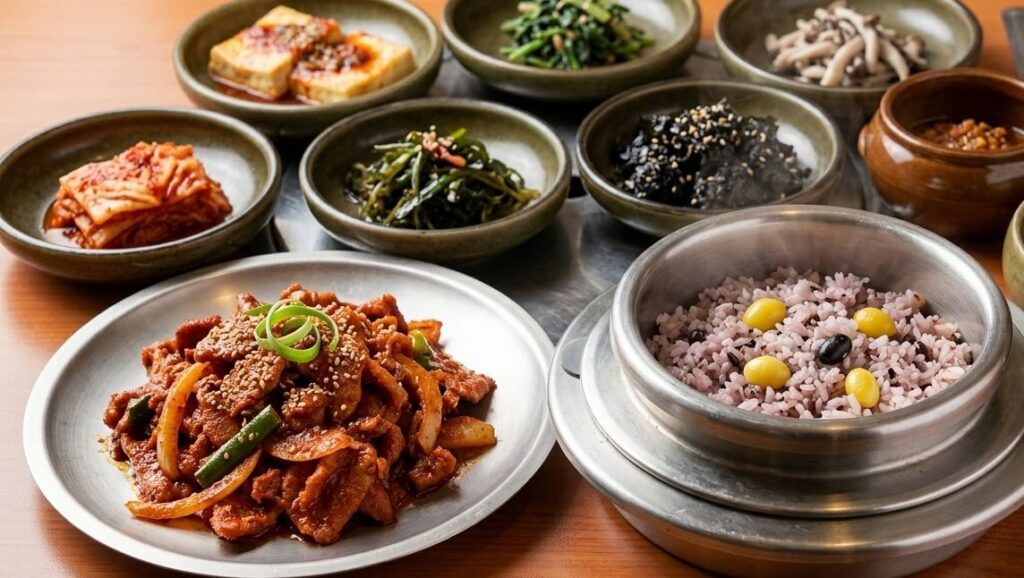
This makes it a useful option for travelers who want to experience a Korean meal with a main dish, rice, and side dishes.
Korean set meals are commonly called jeongsik (정식).
They typically include a main dish accompanied by rice and several smaller dishes.
The exact arrangement depends on the restaurant and the menu ordered.
O’uga Menu and Prices
| Menu | Korean Name | Listed Price |
|---|---|---|
| Spicy Pork Bulgogi Set | 고추장불고기정식 | ₩15,000 |
| Braised Pork Ribs Set | 돼지갈비찜 정식 | ₩16,000 |
| Tteokgalbi Set | 떡갈비 정식 | ₩17,000 |
| Vegetable Wrap Set | 쌈 정식 (고기X) | ₩11,000 |
| Soft Tofu Set Meal | 순두부 백반 | ₩11,000 |
| Kimchi Stew Set Meal | 김치찌개 백반 | ₩11,000 |
| Pork Belly Set | 삼겹살 정식 | ₩17,000 |
| Beef Rib Meat Set | 갈비살 정식 | ₩20,000 |
| Bulgogi Hot Pot With Rice | 불고기전골+솥밥 | ₩17,000 per person |
Prices are based on publicly available menu listings. Bulgogi hot pot is listed with a minimum order of two people.
What Should You Order?
Spicy Pork Bulgogi Set (고추장불고기정식) — ₩15,000
This dish combines pork with a gochujang-based marinade.
Gochujang is a Korean fermented red chili paste.
It provides a combination of chili heat, sweetness, and savory flavor.
Spicy pork bulgogi is generally eaten with rice and side dishes.
It is a useful choice if you enjoy Korean meat dishes but prefer a prepared meal rather than cooking at the table.
Braised Pork Ribs Set (돼지갈비찜 정식) — ₩16,000
Galbijjim refers to Korean braised ribs.
The dish is generally prepared by simmering meat with seasonings until it becomes tender.
Pork galbijjim differs from grilled Korean barbecue because the meat is braised rather than cooked over a grill.
It is worth considering if you prefer slow-cooked meat dishes.
Tteokgalbi Set (떡갈비 정식) — ₩17,000
Tteokgalbi is a Korean meat dish traditionally made with seasoned minced or finely chopped meat.
It is shaped and cooked into a patty-like form.
The name includes tteok, meaning rice cake, although the dish itself is made primarily from meat.
It can be a convenient choice for travelers who prefer meat without large bones.
Bulgogi Hot Pot (불고기전골) — ₩17,000 Per Person
Bulgogi jeongol combines marinated beef with broth and other ingredients.
Depending on the preparation, it may include mushrooms, vegetables, and glass noodles.
Unlike grilled bulgogi, the ingredients are cooked together in a pot.
O’uga’s listed menu includes rice with the hot pot.
Important: The public menu specifies a minimum order of two people.
How Much Should You Budget?
| Order | Estimated Total |
|---|---|
| One Spicy Pork Bulgogi Set | ₩15,000 |
| One Braised Pork Ribs Set | ₩16,000 |
| One Tteokgalbi Set | ₩17,000 |
| Two Spicy Pork Bulgogi Sets | ₩30,000 |
| Two Bulgogi Hot Pot Portions | ₩34,000 |
For two people, budgeting approximately ₩30,000–₩34,000 would cover the example meals above before additional drinks or dishes.
Understanding Korean Side Dishes
Korean set meals often include banchan (반찬).
These are small side dishes served alongside the main meal.
They may include kimchi, seasoned vegetables, pickled ingredients, or other preparations.
The selection varies by restaurant.
Side dishes are generally intended to be eaten together with rice and the main course.
Practical Visiting Tips
O’uga is located near Myeongdong Station.
Search for 오우가 using the Korean address to confirm the correct location.
The restaurant offers both individual set meals and dishes intended for sharing.
If you’re dining alone, check the individual set-meal options.
For two or more people, the bulgogi hot pot provides another way to experience Korean cooking.
Choose O’uga if: You want a traditional Korean rice-based meal with several menu options.
3. Lanju Kalmyeon (란주칼면): Chinese-Style Knife-Shaved Noodles
Best for: Noodle lovers, spicy food enthusiasts, and travelers interested in Chinese-influenced cuisine.
Address: 64 Sogong-ro, Jung-gu, Seoul
Korean address: 서울 중구 소공로 64
Nearest station: Myeongdong Station, Line 4
What Makes Lanju Kalmyeon Different?
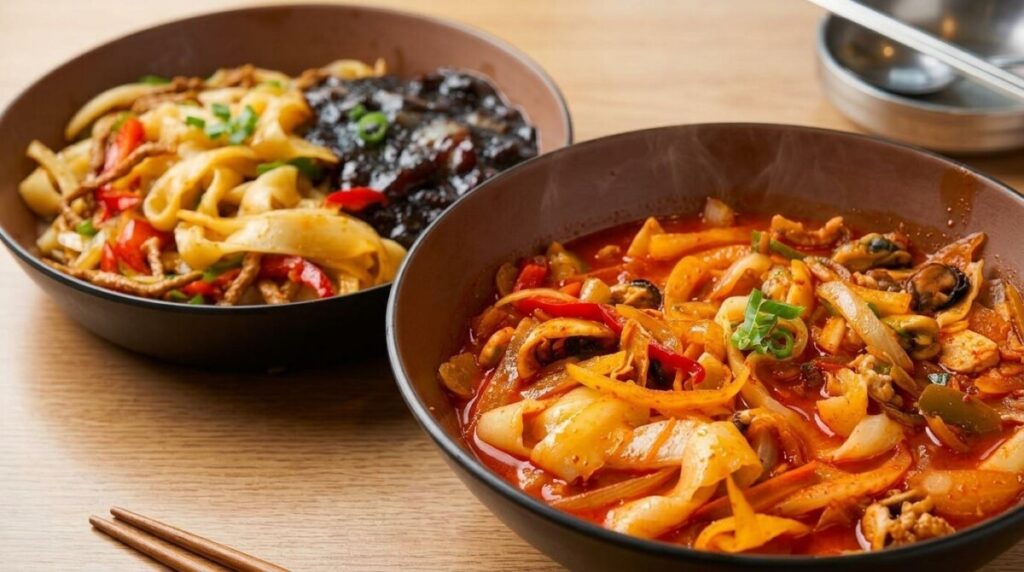
Lanju Kalmyeon specializes in daoxiao mian, commonly called dosakmyeon (도삭면) in Korean.
These are Chinese-style knife-shaved noodles.
Unlike ordinary noodles that are rolled and cut into uniform strips, knife-shaved noodles are traditionally made by shaving pieces from a block of dough.
This creates noodles with irregular shapes and thicknesses.
The resulting texture differs from conventional Korean wheat noodles.
Some pieces may be thicker or chewier than others.
Lanju Kalmyeon serves these noodles in several styles, including spicy seafood soup and stir-fried preparations.
Lanju Kalmyeon Menu and Prices
| Menu | Korean Name | Listed Price |
|---|---|---|
| Seafood Jjamppong Shaved Noodles | 삼선해물짬뽕도삭면 | ₩11,000 |
| Stir-Fried Seafood Shaved Noodles | 삼선해물볶음도삭면 | ₩13,000 |
| Seafood Black Bean Shaved Noodles | 삼선해물볶음간자장도삭면 | ₩10,000 |
| Sichuan Sweet-and-Sour Pork | 사천탕수육·꿔바로우 | ₩29,000 |
| Cumin Lamb Shaved Noodles | 쯔란양고기도삭면 | ₩13,000 |
| Mala Shaved Noodles | 마라탕도삭면 | ₩13,000 |
| Seafood Fried Rice | 해물볶음밥 | ₩12,000 |
Prices are based on publicly available menu listings and may change.
What Should You Order?
Seafood Jjamppong Shaved Noodles (삼선해물짬뽕도삭면) — ₩11,000
Jjamppong is a spicy noodle soup commonly found in Korean-Chinese restaurants.
It generally combines chili-seasoned broth with vegetables and seafood.
Lanju Kalmyeon’s version uses knife-shaved noodles.
This changes the texture compared with conventional jjamppong noodles.
If you enjoy spicy soup and chewy noodles, this is a useful starting point.
However, seafood ingredients may include shellfish, so check carefully if you have allergies.
Seafood Black Bean Shaved Noodles (삼선해물볶음간자장도삭면) — ₩10,000
Jajangmyeon is a Korean-Chinese noodle dish served with black bean sauce.
Lanju Kalmyeon offers a version using knife-shaved noodles.
The sauce is generally savory, with some sweetness.
This may be a better option than spicy jjamppong if you prefer milder flavors.
Sichuan Sweet-and-Sour Pork (사천탕수육·꿔바로우) — ₩29,000
Guobaorou is a Chinese-style fried pork dish associated with a crispy coating and sweet-and-sour sauce.
It differs from many conventional Korean tangsuyuk preparations.
The restaurant’s menu lists a Sichuan-style sweet-and-sour pork dish.
Because it is a larger plate, it is generally more practical to share.
If you’re dining with another person, combining one or two noodle dishes with shared fried pork can provide more variety.
Cumin Lamb Shaved Noodles (쯔란양고기도삭면) — ₩13,000
Cumin is a spice commonly used in several Chinese regional cuisines.
Its distinctive aroma pairs well with lamb.
This dish may appeal to travelers who enjoy stronger spice flavors and want something different from seafood noodles.
How Much Should You Budget?
| Order | Estimated Total |
|---|---|
| Seafood Jjamppong Shaved Noodles | ₩11,000 |
| Seafood Black Bean Shaved Noodles | ₩10,000 |
| Cumin Lamb Shaved Noodles | ₩13,000 |
| Two Seafood Jjamppong Noodles | ₩22,000 |
| Jjamppong + Black Bean Noodles | ₩21,000 |
| Jjamppong + Black Bean Noodles + Guobaorou | ₩50,000 |
For two people ordering two noodle dishes and sharing one plate of guobaorou, the estimated total would be approximately ₩50,000.
This is a more substantial meal than ordering noodles alone.
Practical Visiting Tips
Lanju Kalmyeon is located near Shinsegae Department Store in the Myeongdong area.
Search for 란주칼면 using the address on Sogong-ro.
The restaurant’s listed operating hours are approximately 11:00 AM–9:20 PM, with last orders around 8:30 PM.
Operating hours may change.
If you are dining alone, an individual noodle dish is a practical choice.
If you are visiting with friends, consider sharing a larger fried dish.
Choose Lanju Kalmyeon if: You enjoy chewy noodles, spicy Chinese-style dishes, and meals that can be shared.
4. Miseongok (미성옥): Traditional Korean Seolleongtang
Best for: Solo diners, traditional Korean soup, and travelers looking for a mild meal.
Address: 25-11 Myeongdong-gil, Jung-gu, Seoul
Korean address: 서울 중구 명동길 25-11
Nearest station: Euljiro 1-ga Station, Line 2
Why Visit Miseongok?
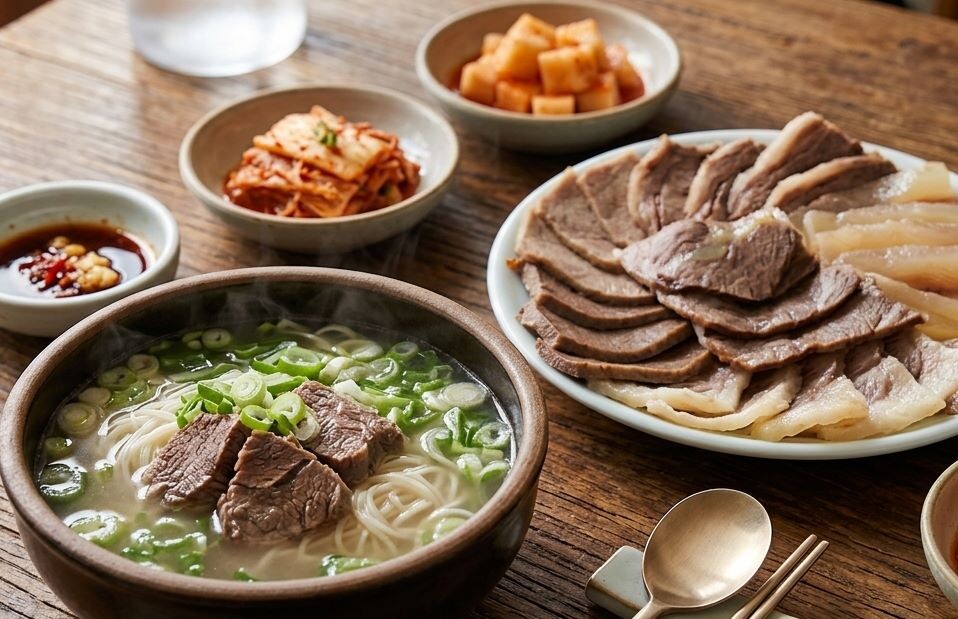
Miseongok is a long-established Korean restaurant specializing in seolleongtang.
Seolleongtang (설렁탕) is a Korean soup made by simmering beef bones and other beef ingredients.
The broth is generally pale or milky in appearance.
Unlike spicy Korean stews, seolleongtang is usually served with relatively mild seasoning.
Customers can adjust the flavor by adding salt, green onions, or other condiments.
Miseongok is associated with a traditional style of Korean soup dining.
For travelers who want something warm and filling without strong chili seasoning, seolleongtang is worth considering.
Miseongok Menu and Prices
| Menu | Korean Name | Listed Price |
|---|---|---|
| Seolleongtang | 설렁탕 | ₩13,000 |
| Special Seolleongtang | 설렁탕 특 | ₩15,000 |
| Boiled Beef Platter — Small | 수육 소 | ₩35,000 |
| Boiled Beef Platter — Large | 수육 대 | ₩45,000 |
Prices are based on public restaurant menu listings.
What Should You Order?
Seolleongtang (설렁탕) — ₩13,000
Seolleongtang is the restaurant’s main specialty.
The soup typically contains beef and thin noodles.
Rice is commonly served alongside it.
The broth may taste relatively mild when first served.
This is intentional in many traditional seolleongtang restaurants.
Rather than expecting a strongly seasoned soup, customers adjust the flavor themselves.
Special Seolleongtang (설렁탕 특) — ₩15,000
The special version generally includes a larger amount of meat.
If you’re particularly hungry or prefer a more meat-focused meal, it may be worth considering.
Suyuk (수육) — ₩35,000–₩45,000
Suyuk refers to boiled meat served in slices.
At Miseongok, it is a beef dish.
Unlike Korean barbecue, the meat is not grilled at the table.
Instead, it is cooked and served ready to eat.
Suyuk is generally more suitable for sharing than ordering as a complete individual meal.
How to Eat Seolleongtang
If you’ve never tried seolleongtang, the following approach may help.
- Taste the broth before adding seasoning.
- Add a small amount of salt.
- Stir and taste again.
- Add green onions if available.
- Eat the beef and noodles with the broth.
- Enjoy the soup with rice and kimchi.
A common accompaniment is kkakdugi (깍두기), a type of kimchi made from cubed radish.
Its acidity and seasoning provide a contrast to the mild soup.
How Much Should You Budget?
| Order | Estimated Total |
|---|---|
| One Seolleongtang | ₩13,000 |
| One Special Seolleongtang | ₩15,000 |
| Two Seolleongtang | ₩26,000 |
| Two Special Seolleongtang | ₩30,000 |
| Two Seolleongtang + Small Suyuk | ₩61,000 |
For a solo traveler, approximately ₩13,000–₩15,000 is a useful budget for an individual soup meal.
Practical Visiting Tips
Miseongok is located in central Myeongdong, within walking distance of Euljiro 1-ga Station.
It is a useful option for travelers who want an individual meal rather than shared Korean barbecue.
Public business listings commonly show early morning opening hours.
This makes it worth checking if you want a Korean breakfast.
However, confirm the current schedule before visiting.
Choose Miseongok if: You want traditional Korean beef soup and prefer mild flavors.
5. Myeongdong Hamheung Myeonok (명동함흥면옥): Korean Cold Noodles
Best for: Cold noodle lovers, travelers visiting during warm weather, and anyone interested in traditional Korean noodle dishes.
Address: 35-19 Myeongdong 10-gil, Jung-gu, Seoul
Korean address: 서울 중구 명동10길 35-19
Nearest station: Myeongdong Station, Line 4
What Makes Hamheung Naengmyeon Different?
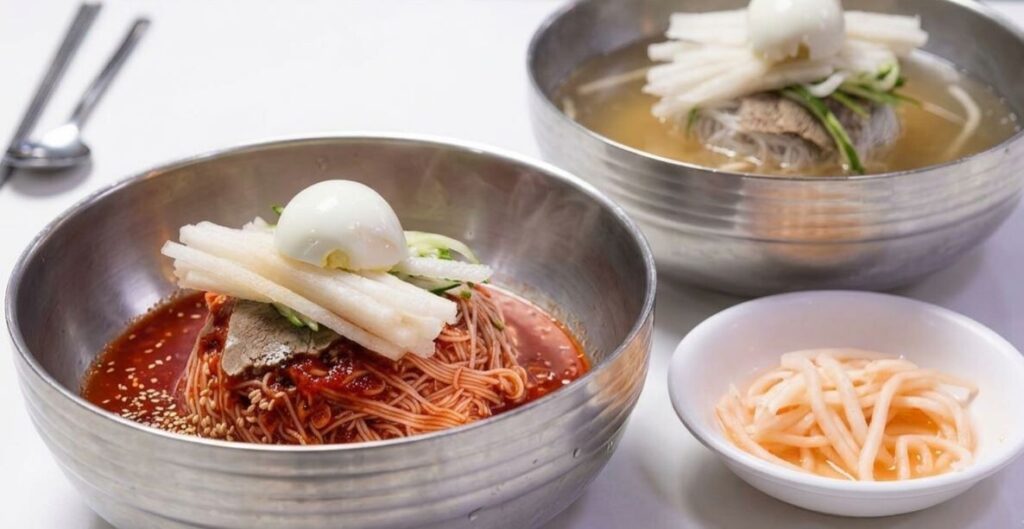
Naengmyeon (냉면) is a Korean cold noodle dish.
Several regional styles exist.
Hamheung-style naengmyeon is commonly associated with thin, chewy noodles made using starch.
The texture differs from ordinary wheat noodles.
Some versions are served with cold broth, while others are mixed with spicy seasoning.
Myeongdong Hamheung Myeonok specializes in this style of Korean noodles.
It offers an alternative to the hot noodle soups served at Myeongdong Kyoja and Miseongok.
Myeongdong Hamheung Myeonok Menu and Prices
| Menu | Korean Name | Listed Price |
|---|---|---|
| Mul Naengmyeon | 물냉면 | ₩13,000 |
| Bibim Naengmyeon | 비빔냉면 | ₩13,000 |
| Hoe Naengmyeon | 회냉면 | ₩14,000 |
| Galbitang | 갈비탕 | ₩16,000 |
| Handmade Mandu | 손만두 | ₩11,000 |
| Two Handmade Mandu | 손만두 2알 | ₩3,800 |
Prices are based on publicly available menu listings and may change.
What Should You Order?
Mul Naengmyeon (물냉면) — ₩13,000
Mul naengmyeon is served in cold broth.
The word mul means water.
The dish generally combines thin noodles with chilled broth and toppings.
Depending on the restaurant, these may include cucumber, radish, egg, or meat.
It is a refreshing option during warm weather.
However, cold noodles are also eaten throughout the year.
Bibim Naengmyeon (비빔냉면) — ₩13,000
Bibim naengmyeon is served with a seasoned sauce rather than a large amount of broth.
The sauce is commonly spicy, sweet, and tangy.
If you prefer stronger flavors, bibim naengmyeon may be more appealing than mul naengmyeon.
Hoe Naengmyeon (회냉면) — ₩14,000
Hoe naengmyeon is a spicy cold noodle dish topped with seasoned fish.
The word hoe refers to raw fish or seafood preparations.
Hamheung-style hoe naengmyeon commonly uses marinated skate or other fish ingredients.
The combination of chewy noodles, spicy sauce, and seasoned fish creates a different experience from ordinary cold noodles.
If you do not eat raw or marinated seafood, choose another noodle option.
Galbitang (갈비탕) — ₩16,000
Galbitang is a Korean beef short rib soup.
Unlike cold noodles, it is served hot.
It commonly contains beef ribs, broth, and other ingredients.
This is a practical alternative if you’re visiting with someone who does not want cold noodles.
Handmade Mandu (손만두) — ₩11,000
Handmade mandu provide another option for diners who want something in addition to noodles.
The restaurant also lists a smaller two-piece serving.
This is useful if you want to try dumplings without ordering a full portion.
How Much Should You Budget?
| Order | Estimated Total |
|---|---|
| One Mul Naengmyeon | ₩13,000 |
| One Bibim Naengmyeon | ₩13,000 |
| One Hoe Naengmyeon | ₩14,000 |
| One Galbitang | ₩16,000 |
| Mul Naengmyeon + Two Mandu | ₩16,800 |
| Two Mul Naengmyeon | ₩26,000 |
| Mul Naengmyeon + Hoe Naengmyeon | ₩27,000 |
For two people, ordering one mul naengmyeon and one hoe naengmyeon would cost approximately ₩27,000.
How to Eat Korean Cold Noodles
Cold noodles may be served with vinegar, mustard, or other condiments.
A useful approach is to taste the noodles and broth before adding anything.
Then adjust the seasoning gradually.
Some restaurants provide scissors for cutting long noodles.
If you find the noodles difficult to eat, ask staff whether scissors are available.
Because Hamheung-style noodles can be particularly chewy, take smaller bites if you’re unfamiliar with the texture.
Practical Visiting Tips
Myeongdong Hamheung Myeonok is located near the main Myeongdong shopping streets.
Public business listings indicate that the restaurant may close on Sundays.
Check the current operating schedule before visiting.
If you are unsure whether you will enjoy cold noodles, consider ordering a hot soup or sharing a noodle dish with someone else.
Choose Myeongdong Hamheung Myeonok if: You enjoy chewy noodles and want to experience Korean cold noodle culture.
Which Myeongdong Restaurant Should You Choose?
The five restaurants offer different dining experiences.
For Your First Korean Meal
Choose Myeongdong Kyoja.
Kalguksu and mandu are approachable Korean dishes.
The menu is relatively straightforward, making it convenient for first-time visitors.
For a Traditional Korean Set Meal
Choose O’uga.
The restaurant offers several rice-based meals with different meat and stew options.
It is particularly useful if you want to try Korean side dishes.
For Spicy Noodles
Choose Lanju Kalmyeon.
The knife-shaved noodles provide a different texture from ordinary Korean noodles.
The spicy seafood version is worth considering if you enjoy chili-based soup.
For a Mild Korean Soup
Choose Miseongok.
Seolleongtang is a traditional Korean beef soup that customers can season according to their preferences.
It is a practical option for travelers who prefer mild food.
For Cold Noodles
Choose Myeongdong Hamheung Myeonok.
The restaurant offers several types of naengmyeon.
Mul naengmyeon is worth considering if you prefer chilled broth, while hoe naengmyeon is an option for travelers who enjoy spicy seafood-based toppings.
How Much Does a Restaurant Meal Cost in Myeongdong?
Based on the representative prices in this guide, individual meals commonly fall between approximately ₩10,000 and ₩20,000.
However, shared dishes can cost considerably more.
| Budget | Example |
|---|---|
| Around ₩10,000 | Lanju Kalmyeon black bean shaved noodles |
| Around ₩12,000 | Myeongdong Kyoja kalguksu |
| Around ₩13,000 | Miseongok seolleongtang |
| Around ₩14,000 | Hamheung Myeonok hoe naengmyeon |
| Around ₩15,000 | O’uga spicy pork bulgogi set |
| Around ₩17,000 | O’uga tteokgalbi set |
| Around ₩29,000 | Lanju Kalmyeon shared guobaorou |
These examples are not a complete price comparison of every menu item.
They are intended to help travelers estimate the cost of specific dishes.
Practical Dining Tips for International Visitors
1. Search Using Korean Restaurant Names
Korean map applications can be useful when navigating Myeongdong’s smaller streets.
| Restaurant | Korean Search Term |
|---|---|
| Myeongdong Kyoja | 명동교자 |
| O’uga | 오우가 |
| Lanju Kalmyeon | 란주칼면 |
| Miseongok | 미성옥 |
| Myeongdong Hamheung Myeonok | 명동함흥면옥 |
Naver Map and KakaoMap are useful options.
Always confirm the exact address before following directions.
2. Understand Individual and Shared Dishes
Not every Korean restaurant uses the same ordering system.
Noodle soups, rice dishes, and individual set meals are generally straightforward to order for one person.
Hot pots and larger meat dishes may require a minimum number of portions.
At O’uga, the listed bulgogi hot pot requires at least two orders.
Check minimum-order requirements before choosing a restaurant.
3. Check Opening Hours and Break Times
Some restaurants close temporarily between lunch and dinner.
This is called break time (브레이크타임).
Others remain open throughout the afternoon.
Last-order times may also be earlier than closing times.
If you plan to eat outside normal lunch or dinner hours, check the latest schedule.
4. Be Careful With Food Allergies
Korean dishes may contain ingredients that are not immediately obvious from the menu name.
Examples include:
- Wheat in noodles and dumplings
- Soy in sauces and marinades
- Seafood in soup broths
- Pork in dumpling fillings
- Beef in traditional soups
- Fish in hoe naengmyeon
If you have food allergies, ask staff to confirm the ingredients and possible cross-contact.
Translation applications can help with communication, but they cannot guarantee that a dish is safe for a particular allergy.
5. Learn a Few Useful Korean Phrases
이거 하나 주세요.
Igeo hana juseyo.
“One of these, please.”
안 맵게 해주세요.
An maepge haejuseyo.
“Please make it less spicy.”
포장 가능해요?
Pojang ganeunghaeyo?
“Can I get this to go?”
카드 돼요?
Kadeu dwaeyo?
“Can I pay by card?”
Not every restaurant can change its seasoning or preparation, so requests may not always be possible.
Planning a Meal and Cafe Visit in Myeongdong
Myeongdong is convenient for combining a restaurant meal with shopping or a café visit.
For example, you could enjoy kalguksu at Myeongdong Kyoja and then explore nearby dessert cafés.
If you prefer a quieter meal, Miseongok offers a different experience centered on traditional Korean beef soup.
Travelers interested in a longer café break can explore our guide to seven cafés in Myeongdong.
For a different Seoul dining neighborhood, see our guide to local restaurants near Hongdae Station.
You can also explore our Michelin Bib Gourmand restaurant guide near Hongdae for another selection of Korean restaurants.
Final Thoughts: Where Should You Eat in Myeongdong?
Myeongdong offers more than street food and shopping.
Its established restaurants serve several different styles of Korean and Chinese-influenced cuisine.
Myeongdong Kyoja is a practical choice for kalguksu and dumplings.
O’uga offers traditional Korean set meals, while Lanju Kalmyeon specializes in Chinese-style knife-shaved noodles.
Miseongok serves seolleongtang, and Myeongdong Hamheung Myeonok focuses on Korean cold noodles.
Rather than choosing a restaurant based only on popularity, consider the type of food you want, your budget, and whether you’re dining alone or with others.
A bowl of noodles may be the most convenient choice for a quick lunch, while a Korean set meal or shared dish can provide a different dining experience.
Information researched on October 17, 2026. Menu prices, operating hours, and restaurant details may change. Confirm current information before visiting.