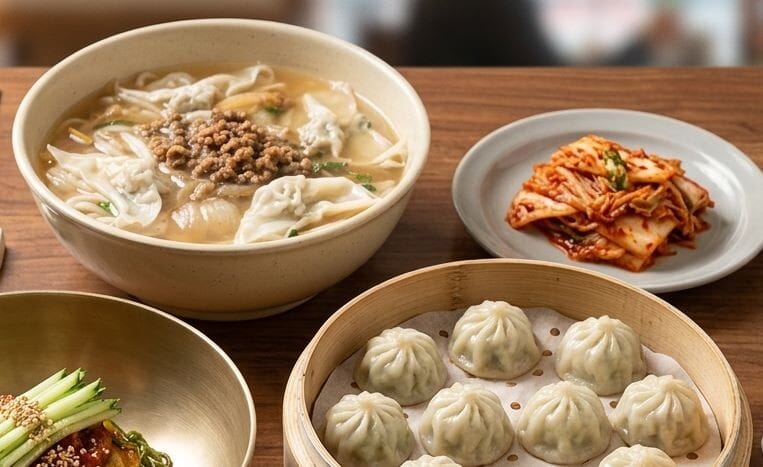
Dongdaemun is one of Seoul’s most interesting neighborhoods for food, but finding the right place to eat isn’t always straightforward.
Around Dongdaemun Design Plaza (DDP), you’ll find modern shopping centers, busy streets, and restaurants serving everything from Korean comfort food to international cuisine.
Walk a little farther into the surrounding neighborhoods, however, and the dining scene changes.
There are small restaurants specializing in traditional soups, inexpensive Korean home-style meals, and braised pork. You can also find a traditional hanok tea house and a popular street-side crepe stand.
This Dongdaemun food guide introduces six places offering different dining experiences.
Rather than ranking them by popularity, we’ll focus on what each place does well, what to order, how much you might spend, and which restaurants best fit your travel plans.
1. Daehwajeong Jinjja Haejangguk (대화정 진짜해장국)
Best for: An early Korean breakfast or a traditional beef soup meal

If you’re looking for something more substantial than a bakery breakfast, Daehwajeong Jinjja Haejangguk is worth considering.
This long-running restaurant specializes in haejangguk (해장국), a Korean soup traditionally associated with meals after drinking alcohol.
Despite its English nickname, “hangover soup,” haejangguk is also an ordinary breakfast or lunch for people who simply enjoy hearty Korean soups.
Daehwajeong is particularly interesting because its soup is built around beef, vegetables, and a savory broth rather than relying entirely on a fiery red chili base.
What to Order
Regular Haejangguk (해장국)
Published menu references indicate a price of approximately ₩12,000.
The soup typically includes beef, leafy vegetables, and seonji (선지), which is cooked blood curd.
For travelers unfamiliar with Korean cuisine, seonji is worth understanding before ordering.
It has a distinctive texture and is not the same as ordinary beef.
If you prefer to avoid blood curd, ask whether the restaurant can prepare your soup without it.
Special Haejangguk (특해장국)
Published references indicate approximately ₩17,000.
The special version is associated with a larger beef-bone portion, making it a more substantial choice.
If you enjoy eating meat directly from the bone, this may be the more interesting option.
Why Choose This Restaurant?
What distinguishes Daehwajeong from many other Dongdaemun restaurants is its early opening time.
The restaurant is listed as opening at 5:00 AM, making it a practical option for travelers who want a traditional Korean breakfast before sightseeing.
The soup also offers a useful introduction to a style of Korean comfort food that differs considerably from barbecue or fried chicken.
Good to know: The restaurant has an afternoon break between its daytime and evening service.
Location
Address: 249-20 Jangchungdan-ro, Jung-gu, Seoul
Korean address: 서울 중구 장충단로 249-20
Nearby station: Dongdaemun History & Culture Park Station
Published hours: 5:00 AM–2:40 PM and 5:00 PM–11:50 PM
Search for 대화정 진짜해장국 on a Korean map application.
2. Cheonil Samgyetang (천일삼계탕)
Best for: Travelers who want a traditional Korean chicken soup

Samgyetang (삼계탕) is one of Korea’s most recognizable traditional chicken dishes.
Unlike fried chicken, samgyetang is prepared by simmering a small chicken in broth, commonly with ingredients such as glutinous rice, garlic, and ginseng.
Cheonil Samgyetang is a small restaurant near Dongdaemun that focuses on this dish.
The restaurant’s limited menu is part of its appeal.
Rather than offering dozens of unrelated dishes, it concentrates on a traditional Korean soup that can be enjoyed as a complete meal.
What to Order
Samgyetang (삼계탕)
This is the restaurant’s main specialty.
A serving typically arrives in a hot earthenware bowl with a whole small chicken in broth.
The chicken is cooked until tender, and diners can separate the meat from the bones using chopsticks and a spoon.
The broth is associated with a long-simmered chicken stock.
One interesting detail mentioned in descriptions of Cheonil Samgyetang is the use of chicken feet in preparing the broth.
This is different from simply boiling chicken in water and contributes to the restaurant’s distinctive soup-making approach.
How to Eat Samgyetang
Start by tasting the broth before adding seasonings.
Depending on your preference, you can add a little salt or garlic.
Use your spoon and chopsticks to separate the chicken meat, taking care around the small bones.
Samgyetang is commonly served with kimchi or other simple side dishes.
What Makes Cheonil Samgyetang Worth Visiting?
The restaurant is associated with limited daily production.
Older descriptions mention approximately 80 servings per day, although that number has not been independently confirmed as a current operating policy.
What matters for visitors is that the restaurant may finish service before its posted closing time if the prepared soup sells out.
Another important consideration is accessibility.
The dining area is reported to be upstairs, which may be inconvenient for travelers with strollers, heavy luggage, or mobility limitations.
Location
Address: 43 Jangchungdan-ro 13-gil, Jung-gu, Seoul
Korean address: 서울 중구 장충단로13길 43
Nearby station: Dongdaemun History & Culture Park Station
Published hours: 10:00 AM–8:00 PM, Monday–Saturday
Sunday: Listed as closed
Search for 천일삼계탕 to find the correct restaurant.
3. Yangji Sikdang (양지식당)
Best for: An affordable Korean home-style lunch

If you want to experience a typical Korean lunch rather than a restaurant specializing in one famous dish, Yangji Sikdang offers something different.
The restaurant serves baekban (백반), a traditional Korean set meal built around rice, soup, and several side dishes.
Baekban is a familiar part of everyday Korean dining.
Unlike a restaurant where you select several individual dishes, a baekban restaurant may serve a predetermined meal that changes depending on the day.
Yangji Sikdang is known for this straightforward approach.
What to Order
Home-Style Baekban (백반)
Published price references generally place the meal around ₩9,000–₩10,000.
The set meal includes rice, soup, and a variety of banchan (반찬), or Korean side dishes.
Depending on the day, the meal may include fish, vegetables, kimchi, and other prepared dishes.
The original First Korea Food article describes a spread of nine side dishes.
However, the exact number and selection should not be treated as guaranteed because the menu changes.
Friday Jeyuk Baekban (제육백반)
Friday is associated with jeyuk-bokkeum (제육볶음), a Korean dish made with spicy stir-fried pork.
If you enjoy Korean pork dishes and chili-based seasoning, Friday may be an interesting day to visit.
Confirm the day’s menu before making a special trip.
Why Yangji Sikdang Stands Out
The biggest attraction is the opportunity to experience a Korean meal built around several small dishes rather than one large main course.
For first-time visitors, this provides a useful introduction to banchan culture.
You can sample different vegetables, seasonings, and cooking styles in a single meal.
However, there is an important trade-off.
Because the menu is largely predetermined, Yangji Sikdang may not be ideal for travelers with strict dietary restrictions or those who want to choose every component of their meal.
Important Visiting Tip
Yangji Sikdang is primarily a lunch restaurant.
Published hours are 10:00 AM–2:30 PM, Monday through Saturday.
It is listed as closed on Sundays.
This is not a restaurant to save for dinner after shopping.
Location
Address: 4 Yulgok-ro 29-gil, Jongno-gu, Seoul
Korean address: 서울 종로구 율곡로29길 4
Nearby station: Dongdaemun Station
Search for 양지식당.
4. Waglwagl Jokbal (와글와글족발)
Best for: Friends or couples who want to share a traditional Korean pork dish

Jokbal (족발) is a Korean dish made from braised pig’s trotters.
The pork is cooked until the meat becomes tender and the skin develops its characteristic chewy texture.
It is usually sliced and served with vegetables, sauces, and side dishes.
Waglwagl Jokbal is a long-running restaurant in Changsin-dong near Dongdaemun Station.
Unlike a restaurant offering many different Korean dishes, its main attraction is traditional jokbal.
What to Order
Jokbal (족발)
Older published menu references place a shared order in approximately the ₩30,000–₩40,000 range, depending on size.
Current prices should be confirmed before ordering.
Jokbal is typically served as a platter rather than an individual bowl.
This makes it a practical choice for two or more diners.
The pork can be eaten on its own or wrapped in lettuce with accompanying vegetables and sauces.
Vegetable Bibimbap (야채비빔밥)
One of the more distinctive details from the original article is the recommendation to order vegetable bibimbap alongside the jokbal.
This combination is worth considering.
The rice and vegetables provide a different texture from the braised pork, while the seasonings add variety to the meal.
If you’re sharing a platter of jokbal, an additional rice dish can also make the meal feel more complete.
Who Should Choose Waglwagl Jokbal?
Choose this restaurant if you enjoy pork dishes and want a shared Korean meal.
Jokbal is particularly interesting for travelers who have already tried Korean barbecue and want to explore another traditional pork preparation.
However, it may not be the best option for solo travelers.
A full platter can be a relatively large order for one person, and the restaurant’s smaller dining space may be less convenient for travelers carrying luggage.
Good to Know
Waglwagl Jokbal is associated with limited daily preparation and may sell out before closing.
Published operating information also differs between sources, particularly regarding Sunday service.
Check the current schedule before visiting.
Location
Address: 18 Changsin-gil, Jongno-gu, Seoul
Korean address: 서울 종로구 창신길 18
Nearby station: Dongdaemun Station
Published hours: Approximately 3:30 PM–10:00 PM
Search for 와글와글족발.
5. Cha Cha Tea Club Changsin Hanok (차차티클럽 창신한옥)
Best for: Traditional tea, Korean-inspired desserts, and a slower break from sightseeing

Not every food stop in Dongdaemun needs to be a full restaurant meal.
Cha Cha Tea Club Changsin Hanok offers a different experience inside a renovated traditional Korean house.
The tea house is located in a narrow alley in Changsin-dong, away from the larger shopping streets.
Its setting is one of the main reasons to visit.
Instead of the familiar layout of a modern coffee shop, visitors can enjoy tea in a space that retains traditional Korean architectural elements.
What to Order
Sagyechun Tea (사계춘) — ₩9,000
Sagyechun is a type of oolong tea.
It is a suitable option for visitors who want to explore traditional tea rather than order a familiar coffee drink.
One of the interesting aspects of Cha Cha Tea Club is the opportunity to prepare tea using dedicated teaware.
This makes the visit more interactive than simply receiving a finished drink.
Banga Coco Fizz (방아 코코피즈) — ₩8,300
For something more unusual, consider Banga Coco Fizz.
Published menu descriptions identify it as a nonalcoholic drink combining ingredients such as quince, lime, coconut milk, and Korean aromatic herbs.
It offers an alternative for visitors who prefer a modern tea-inspired beverage.
What Makes This Tea House Special?
Cha Cha Tea Club combines a traditional setting with contemporary drinks and desserts.
The original article highlights the building’s connection to the former Sidae Inn.
The old inn signage remains a recognizable feature associated with the entrance.
This is particularly useful to know because the tea house can be easy to miss when approaching through the surrounding alley.
Inside, the focus is on tea rather than conventional espresso-based coffee drinks.
If you’re looking specifically for an Americano, another café may be a better choice.
Is It Worth the Detour?
I would prioritize Cha Cha Tea Club if you’re interested in Korean tea culture or want a quieter activity between sightseeing stops.
It is less suitable for travelers who need a very quick takeaway drink.
Tea preparation and limited seating can make the experience more time-consuming than a typical café visit.
Location
Address: 13 Jong-ro 46ga-gil, Jongno-gu, Seoul
Korean address: 서울 종로구 종로46가길 13
Nearby station: Dongdaemun Station
Published hours:
- Weekdays: 1:00 PM–10:00 PM
- Weekends: 11:00 AM–10:00 PM
Published last order: 9:30 PM
Search for 차차티클럽 창신한옥.
6. Dongdaemun Halabeoji Crepe (동대문 할아버지 크레페)
Best for: A quick dessert near Dongdaemun History & Culture Park Station

Dongdaemun Halabeoji Crepe is a small street-side dessert stand associated with the area around Dongdaemun History & Culture Park Station.
The Korean name translates roughly to “Dongdaemun Grandpa Crepe.”
Unlike the traditional Korean restaurants in this guide, the stall specializes in sweet crepes filled with fruit and other toppings.
Its appeal is straightforward.
You can pick up a dessert without committing to another full restaurant meal.
What to Order
Strawberry and Banana Crepe (딸기바나나 크레페)
The combination of fresh fruit and a thin crepe is a familiar choice.
Depending on the current menu, toppings may include chocolate spread, whipped cream, or ice cream.
Banana Crepe (바나나 크레페)
For a simpler option, consider the banana crepe.
Older published menus list banana crepes from approximately ₩3,000, but current prices have not been independently confirmed.
Check the displayed menu before ordering.
Why Visit?
The main advantage is convenience.
The stall is associated with Exit 13 of Dongdaemun History & Culture Park Station, making it an easy dessert stop if you’re already exploring the surrounding shopping area.
The original First Korea Food article also describes watching the crepes being prepared and observing careful cleaning practices.
These are potentially valuable firsthand details, but they should be retained as personal observations only if the original author actually witnessed them.
Important Visiting Tip
Unlike a conventional café, this stand does not necessarily follow fixed restaurant hours.
Published visitor reports describe limited operating periods and early closing when ingredients sell out.
For that reason, do not plan an entire Dongdaemun itinerary around a guaranteed crepe purchase.
Treat it as an optional stop and check recent operating information before visiting.
Location
Area: Near Exit 13, Dongdaemun History & Culture Park Station
Korean name: 동대문 할아버지 크레페
The exact current stall position and operating schedule should be checked before visiting.
Which Dongdaemun Restaurant Should You Choose?
These six places offer very different experiences.
The most useful choice depends on your schedule, budget, and what you want to eat.
Best for an Early Breakfast
Daehwajeong Jinjja Haejangguk
Its early opening time makes it useful for travelers who want a substantial Korean breakfast.
The soup is also a good introduction to traditional Korean comfort food.
Best for a Traditional Korean Lunch
Cheonil Samgyetang
Choose this restaurant if you want to try ginseng chicken soup in a small, specialized restaurant.
It is particularly suitable for solo travelers who prefer an individual meal.
Best for Budget-Conscious Travelers
Yangji Sikdang
The home-style set meal provides rice, soup, and several side dishes for a comparatively modest price.
Its limited lunch hours are the main drawback.
Best for Sharing Dinner
Waglwagl Jokbal
Jokbal is naturally suited to sharing.
For two or more people who enjoy pork, this may be the most appropriate dinner option among the restaurants in this guide.
Best for a Relaxing Afternoon
Cha Cha Tea Club Changsin Hanok
Choose the tea house if you want to explore traditional Korean tea culture in a hanok setting.
Best for a Quick Dessert
Dongdaemun Halabeoji Crepe
The crepe stand is a convenient optional stop when it’s operating.
However, its uncertain schedule makes it less reliable than the other locations for advance planning.
How to Plan a Dongdaemun Food Walk
Dongdaemun is easier to explore when you understand its two main subway areas.
Dongdaemun History & Culture Park Station
This station is served by Subway Lines 2, 4, and 5.
It is convenient for visiting DDP and the surrounding shopping district.
Daehwajeong Jinjja Haejangguk and Cheonil Samgyetang are located in this broader area.
The crepe stand is also associated with an exit at this station.
Dongdaemun Station
Dongdaemun Station is served by Subway Lines 1 and 4.
It is closer to the Changsin-dong area, where several of the other recommendations are located.
Yangji Sikdang, Waglwagl Jokbal, and Cha Cha Tea Club can fit into an itinerary exploring this side of Dongdaemun.
A Practical Food-Focused Itinerary
If you’re spending most of the day around DDP, consider starting with a traditional soup meal.
After exploring DDP and the shopping streets, you can move toward Dongdaemun Station and Changsin-dong.
Depending on the time, you might stop for tea or choose a shared jokbal dinner.
The crepe stand works best as an optional addition rather than a scheduled destination.
You don’t need to visit all six places in one day.
Choosing one main restaurant and one dessert or tea stop will usually make for a more comfortable food-focused outing.
What International Travelers Should Know
Check Korean Restaurant Names
Several restaurants in this guide have English names that can be written in different ways.
For navigation, Korean names are generally more reliable.
Search the exact Korean restaurant name in Naver Map or KakaoMap.
Understand the Difference Between Individual and Shared Meals
Haejangguk, samgyetang, and baekban are generally ordered as individual meals.
Jokbal is usually served as a larger platter suitable for sharing.
This distinction matters when planning your budget or dining alone.
Be Aware of Ingredients
Some traditional Korean dishes contain ingredients that may be unfamiliar.
Haejangguk can include blood curd.
Jokbal is made from pork trotters.
Samgyetang contains chicken and may include ginseng and other ingredients.
If you have food allergies or dietary restrictions, confirm the ingredients directly with the restaurant.
Check Operating Hours Before Traveling
Small Korean restaurants sometimes have afternoon breaks, limited lunch service, or early sell-outs.
This is especially relevant for Cheonil Samgyetang, Yangji Sikdang, and the crepe stand.
Don’t assume every restaurant will be open throughout the afternoon.
More Seoul Food Guides
If you’re exploring other parts of central Seoul, these guides can help you plan additional meals.
For traditional market food, see our Gwangjang Market food guide, which introduces Korean street-food dishes and market dining options.
If you’re planning to walk along the stream through central Seoul, explore our Michelin-recognized restaurants near Cheonggyecheon guide.
For a broader introduction to local Korean dining, read our Korean restaurant guide.
Dongdaemun Food Guide: Quick Comparison
| Restaurant | Specialty | Best For | Price Reference |
|---|---|---|---|
| Daehwajeong Jinjja Haejangguk | Korean beef soup | Early breakfast | Haejangguk ~₩12,000 |
| Cheonil Samgyetang | Ginseng chicken soup | Traditional Korean lunch | Check current menu |
| Yangji Sikdang | Korean home-style set meal | Budget lunch | Around ₩9,000–₩10,000 |
| Waglwagl Jokbal | Braised pork trotters | Shared dinner | Jokbal in the ₩30,000 range |
| Cha Cha Tea Club | Traditional tea and desserts | Hanok tea experience | Sagyechun ₩9,000 |
| Dongdaemun Halabeoji Crepe | Fruit-filled crepes | Quick dessert | Check current stall prices |
Prices are based on publicly available restaurant information and may change. Some figures are approximate historical or third-party references rather than confirmed current in-store prices.
One important detail: Dongdaemun Station and Dongdaemun History & Culture Park Station are different subway stations.
The restaurants in this guide are spread across both areas, so it’s worth checking their locations before planning your route.
Final Thoughts
Dongdaemun offers more than shopping malls and late-night fashion markets.
Its surrounding streets are home to traditional soup restaurants, inexpensive Korean set meals, and casual places specializing in dishes that have long been part of everyday Korean dining.
For an early breakfast, Daehwajeong Jinjja Haejangguk is worth considering.
For a traditional lunch, Cheonil Samgyetang and Yangji Sikdang offer two very different experiences.
Waglwagl Jokbal is better suited to sharing, while Cha Cha Tea Club provides a quieter tea-focused stop.
And if the Dongdaemun crepe stand is open, it can make a convenient dessert stop.
Rather than trying to visit every location, choose the places that fit your schedule and the Korean foods you’re most interested in experiencing.