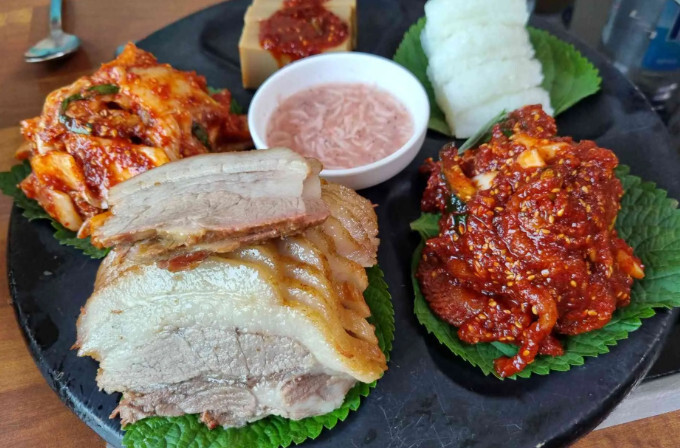
Gwangjang Market is one of Seoul’s most famous places to experience Korean street food. But if you’re visiting for the first time, deciding what to eat can be surprisingly difficult.
Walk into the food alleys and you’ll find vendors preparing mung bean pancakes, handmade noodles, spicy rice cakes, and small rolls of gimbap. Nearby restaurants specialize in Korean beef tartare and traditional fish stew.
The challenge isn’t finding food. It’s choosing which dishes are worth trying without filling up at the first stall.
This Gwangjang Market food guide focuses on eight established food spots, from well-known street-food vendors to restaurants serving more substantial meals.
You’ll also find practical advice on navigating the market, understanding menu prices, and choosing the right foods for your visit.
Gwangjang Market at a Glance
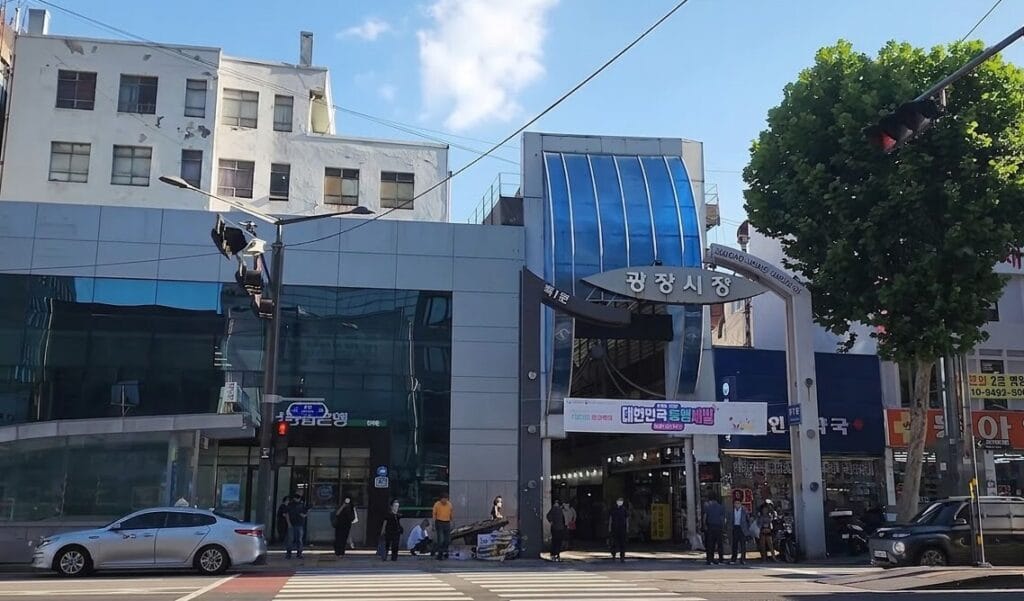
Korean name: 광장시장
Address: 88 Changgyeonggung-ro, Jongno-gu, Seoul
Korean address: 서울특별시 종로구 창경궁로 88
Nearest subway station: Jongno 5-ga Station, Line 1
Recommended subway exit: Exit 8
Food alley hours: Generally 9:00 AM–11:00 PM
Main market hours: Generally 9:00 AM–6:00 PM
Sunday: The main shopping market is generally closed, but the food alley operates year-round.
These are general market hours, not guaranteed operating hours for every individual stall.
Gwangjang Market has operated since 1905 and is recognized as one of Korea’s earliest permanent markets.
Although international visitors often associate it with street food, the market also contains textile shops, traditional clothing stores, and other businesses.
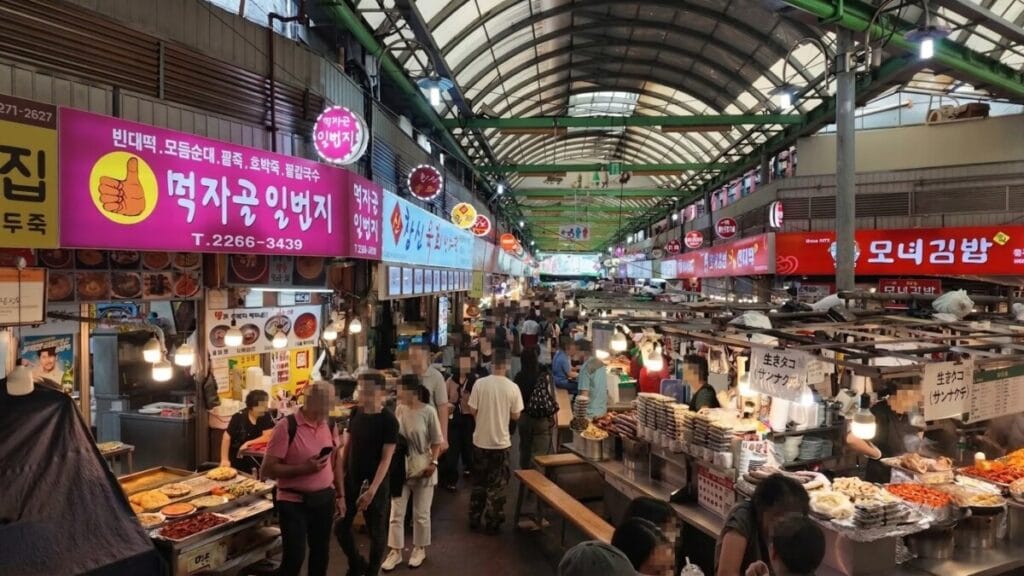
For food-focused travelers, the most useful areas are the interconnected food alleys around the market’s main entrances.
What Should You Eat at Gwangjang Market?
If you have limited time, start by choosing a few different types of food rather than ordering several similar dishes.
| Food Spot | What to Try | Best For |
|---|---|---|
| Gwangjang Market Chapssal Kkwabaegi | Twisted rice doughnut | Quick sweet snack |
| Ganggane Tteokbokki | Radish-based tteokbokki | Spicy Korean street food |
| Sunhui-ne Bindaetteok | Mung bean pancake | Traditional savory snack |
| Monyeo Gimbap | Mayak gimbap | Small, shareable bites |
| Gohyang Kalguksu | Handmade knife-cut noodles | Filling noodle meal |
| Buchon Yukhoe | Korean beef tartare | Adventurous diners |
| Bakgane Bindaetteok | Mung bean pancake | Groups wanting several dishes |
| Eunseong Hoetjip | Spicy codfish stew | Traditional Korean soup |
For a first visit, I would prioritize three different experiences: one savory snack, one noodle or rice dish, and one dessert.
That gives you a better introduction to the market than ordering several full meals at the beginning.
1. Gwangjang Market Chapssal Kkwabaegi (광장시장 찹쌀꽈배기)
Best for: A quick dessert or an inexpensive street-food snack
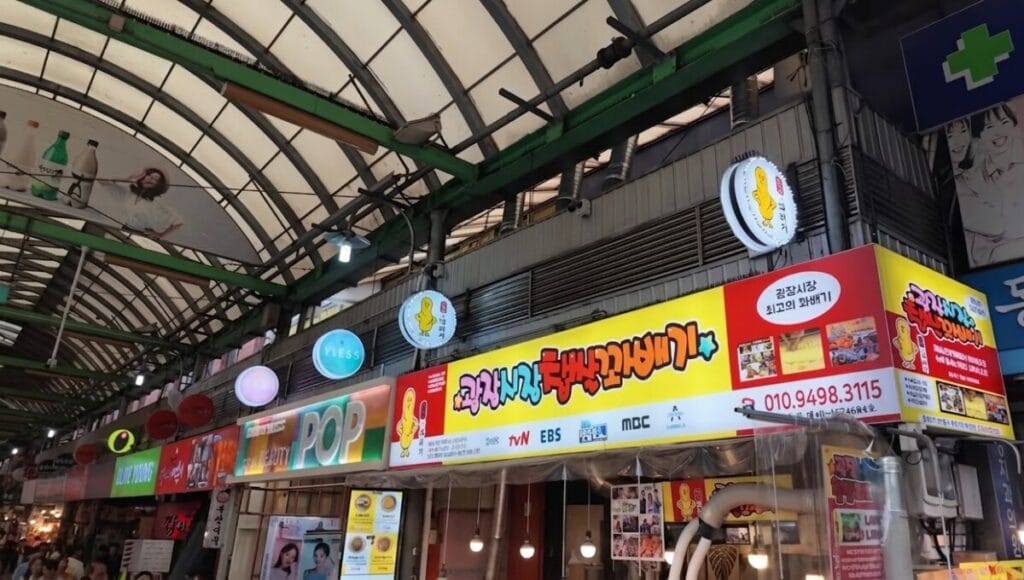
One of the simplest foods to try at Gwangjang Market is kkwabaegi (꽈배기), a twisted Korean doughnut.
Gwangjang Market Chapssal Kkwabaegi specializes in a version made with glutinous rice flour.
Unlike a typical Western doughnut, chapssal kkwabaegi has a distinctive chewy texture.
The dough is twisted, fried, and usually coated with sugar.
What to Order
Chapssal Kkwabaegi (찹쌀꽈배기)
This is the signature item and the most straightforward choice for a first visit.
The contrast between the fried exterior and chewy interior is what distinguishes this style of doughnut.
The original article also highlights a sweet potato mousse-filled doughnut as another option.
If you’re interested in Korean-style sweet potato desserts, it may be worth considering when available.
Why Visit?
Kkwabaegi is easy to eat without committing to a full meal.
It is particularly convenient if you’re exploring the market with friends and want to try several different foods.
The stall is associated with the North Gate 2 area, making it a useful starting point or final dessert stop.
Price note: The original article listed a basic doughnut at ₩1,000, but the current price has not been independently confirmed.
2. Ganggane Tteokbokki (강가네떡볶이)
Best for: Visitors who want to try a different style of Korean tteokbokki
Tteokbokki is one of Korea’s most recognizable street foods.
The familiar version consists of chewy rice cakes coated in a red chili-based sauce.
Ganggane Tteokbokki stands out because of its preparation method.
The restaurant is associated with using grated Korean radish to help develop the sauce rather than relying only on water.
This gives the dish a distinctive identity among the many tteokbokki stalls in Seoul.
What to Order
Ganggane Tteokbokki (강가네떡볶이)
The main attraction is the restaurant’s signature rice cake dish.
Korean radish contains considerable moisture, and grated radish can contribute both liquid and natural sweetness during cooking.
This approach differs from simpler tteokbokki preparations that rely primarily on water, chili paste, and sugar.
However, the exact ingredients and spice level should be confirmed if you have dietary restrictions.
Is It Worth Trying?
Ganggane is a useful choice for travelers who have already tried ordinary street-food tteokbokki and want to compare different preparations.
It is also an interesting introduction to how individual Korean vendors develop their own versions of familiar dishes.
The original article lists tteokbokki at ₩5,000, but that figure should be treated as a historical reference until the current menu is confirmed.
My recommendation: Choose Ganggane if tteokbokki is one of your priorities. Otherwise, consider saving room for a dish you haven’t tried before.
3. Sunhui-ne Bindaetteok (순희네빈대떡)
Best for: Traditional Korean pancakes and a classic market-food experience
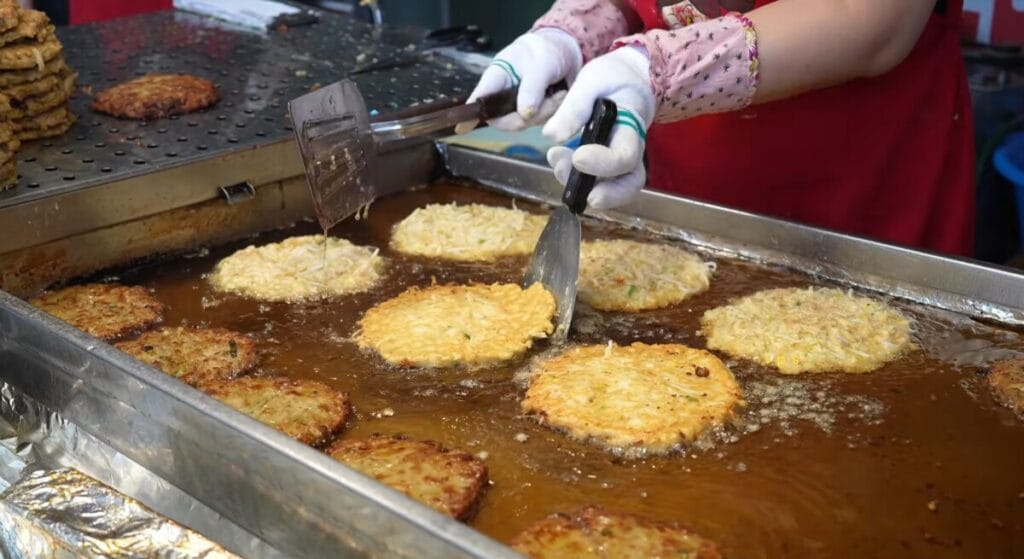
Bindaetteok (빈대떡) is one of Gwangjang Market’s signature foods.
Unlike ordinary flour-based pancakes, traditional bindaetteok is made primarily from ground mung beans.
The batter is cooked on a hot griddle until the exterior develops a golden crust.
Sunhui-ne Bindaetteok is one of the market’s established names for this dish.
What to Order
Mung Bean Pancake (빈대떡)
This is the main reason to visit.
The original article highlights the traditional stone-milling process used to grind mung beans.
Stone-ground mung bean batter is an important part of the traditional preparation associated with this style of pancake.
The pancakes are commonly served with a soy-based dipping sauce containing onions.
The sharp, tangy sauce provides a contrast to the rich fried pancake.
Meat Pancake (고기완자)
If you prefer a meat-based dish, consider gogi wanja.
This is a Korean-style meat patty cooked on a griddle.
It offers a different flavor and texture from mung bean pancakes.
What Makes It Worth Visiting?
Sunhui-ne is particularly appealing if you want to try a dish closely associated with Gwangjang Market’s food culture.
However, bindaetteok can be quite filling.
If you’re planning to visit several stalls, sharing one pancake may be more practical than ordering an entire serving for each person.
For takeaway, reheating the pancake in a dry pan or air fryer may help restore some of its crispness.
Price note: The original article lists mung bean pancakes at approximately ₩5,000–₩6,000. Current in-store prices require confirmation.
4. Monyeo Gimbap (모녀김밥)
Best for: Small portions and one of Gwangjang Market’s most recognizable snacks
Gimbap is a Korean dish made by rolling rice and fillings inside dried seaweed.
At Monyeo Gimbap, the specialty is mayak gimbap (마약김밥).
Despite its unusual English translation, the name does not mean the food contains drugs.
It is a colloquial name referring to how appealing and easy to keep eating these small rolls can be.
What to Order
Mayak Gimbap (마약김밥)
These miniature rolls typically contain rice, carrot, and pickled radish wrapped in seaweed.
Unlike larger Korean gimbap rolls filled with several ingredients, mayak gimbap is intentionally simple.
The mustard-based dipping sauce is an important part of the traditional serving style.
Its sharp flavor contrasts with the relatively mild rice and vegetables.
Why Choose Monyeo Gimbap?
The small size makes mayak gimbap especially convenient for a market-food tour.
You can share a portion without becoming as full as you might after eating a large bowl of noodles.
However, don’t assume the dish is completely vegetarian simply because the visible fillings are vegetables.
Seasonings, dipping sauces, and preparation methods should be checked if you follow a strict vegetarian or vegan diet.
The original article also mentions tofu pockets and tteokbokki, but mayak gimbap remains the clearest first-order recommendation.
Price note: Earlier published references place a portion around ₩3,000–₩4,000. The current price should be checked at the stall.
5. Gohyang Kalguksu (고향칼국수)
Best for: Handmade noodles and travelers interested in Korean food documentaries
Gohyang Kalguksu is one of Gwangjang Market’s internationally recognized noodle stalls.
It appeared in the Seoul episode of Netflix’s Street Food: Asia, released in 2019.
The documentary introduced viewers to the stall’s traditional noodle-making process.
For visitors interested in Korean food culture, this is one of the more distinctive experiences in the market.
What to Order
Kalguksu (칼국수)
Kalguksu means knife-cut noodles.
The noodles are made by rolling dough and cutting it into strips rather than using a conventional noodle-extruding machine.
They are served in a warm broth, commonly prepared with ingredients such as dried anchovies and vegetables.
Unlike spicy tteokbokki, kalguksu is generally a milder dish.
That makes it an appealing option for travelers who prefer warm, savory food without strong chili heat.
Mandu (만두)
Korean dumplings are another dish worth considering.
If a noodle-and-dumpling combination is available, it can be a practical way to try both specialties without ordering two separate full meals.
Is the Netflix-Famous Stall Worth Visiting?
Gohyang Kalguksu is most interesting for travelers who appreciate handmade noodles and want to see a traditional Korean cooking technique.
However, the documentary’s popularity can attract visitors specifically looking for the featured stall.
If your main goal is simply to eat a bowl of kalguksu, other noodle vendors in the market may also be worth considering.
The important distinction is between visiting for the food itself and visiting because of the documentary.
Both are reasonable reasons, but they create different expectations.
Price note: A documented visitor menu from October 2024 listed kalguksu at ₩7,000. This is a historical reference, not a confirmed October 2026 price.
6. Buchon Yukhoe (부촌육회)
Best for: Korean beef tartare and visitors interested in traditional raw beef dishes
Buchon Yukhoe is located in Gwangjang Market’s well-known beef tartare area.
The restaurant has a long history and has received recognition from the Michelin Guide in previous editions.
Unlike the street-food stalls serving pancakes and noodles, Buchon specializes in raw beef dishes.
What to Order
Yukhoe (육회)
Yukhoe is Korean beef tartare.
It typically consists of thinly sliced raw beef seasoned with ingredients such as sesame oil and served with accompaniments that may include Korean pear and egg yolk.
The combination of raw beef, sesame seasoning, and crisp pear is characteristic of the dish.
For travelers familiar with European steak tartare, yukhoe offers an interesting Korean variation.
Yukhoe Bibimbap (육회비빔밥)
This is another practical option.
It combines raw beef with rice and vegetables.
For someone who wants to try yukhoe but prefers a rice-based meal, yukhoe bibimbap may be easier to approach than a large plate of raw beef alone.
How Much Does It Cost?
Publicly available menu information researched in October 2026 lists:
- Yukhoe, 200g: ₩23,000
- Yukhoe Bibimbap: ₩11,000
These are published reference prices and may differ from the current in-store menu.
Michelin Recognition
Buchon Yukhoe has received Michelin Guide recognition in earlier editions.
However, historical recognition should not be confused with a confirmed current Bib Gourmand distinction.
Check the latest Michelin Guide if the restaurant’s current award status is important to your decision.
Important Food Safety Considerations
Yukhoe is served raw.
Raw beef carries a greater foodborne illness risk than properly cooked beef, even when prepared by an established restaurant.
Pregnant travelers, young children, older adults, and people with weakened immune systems should avoid raw or undercooked meat.
The restaurant is also associated with dishes combining raw beef and chopped raw octopus.
Raw octopus requires additional caution because moving pieces and suction cups can create a choking hazard.
If you’re uncomfortable with raw seafood, there is no reason to order it simply because it’s a well-known Korean dish.
Location
Address: 200-12 Jong-ro, Jongno-gu, Seoul
Korean address: 서울 종로구 종로 200-12
Search for 부촌육회 to locate the restaurant.
7. Bakgane Bindaetteok (박가네빈대떡)
Best for: Groups who want several Korean market dishes in one place
Bakgane Bindaetteok offers another way to experience traditional mung bean pancakes.
The main difference from a small single-specialty stall is the broader selection of dishes associated with the restaurant.
The original article highlights bindaetteok, yukhoe, and kalguksu as options.
This makes Bakgane worth considering for groups with different preferences.
What to Order
Bindaetteok (빈대떡)
The mung bean pancake is the obvious starting point.
If you’re interested in comparing different vendors’ versions of the same traditional dish, Bakgane and Sunhui-ne offer two places to consider.
However, there is no reliable basis for claiming that one makes objectively better pancakes than the other.
Yukhoe (육회)
Raw beef is another menu option associated with the restaurant.
For groups interested in both pancakes and beef tartare, having these dishes available in one place may be more convenient than visiting separate vendors.
Why Choose Bakgane?
The main advantage is flexibility.
Instead of moving between several crowded food stalls, a group may prefer sitting down and ordering different dishes together.
The original article describes a two-story dining space, although the current seating arrangement has not been independently verified.
Check the branch’s current menu and seating availability before making a special trip.
Price note: The original article lists bindaetteok at approximately ₩5,000–₩6,000, but the current price has not been confirmed.
8. Eunseong Hoetjip (은성횟집)
Best for: A traditional Korean fish stew rather than street-food snacks
If you’ve already tried the market’s pancakes and rice cakes, Eunseong Hoetjip offers a different kind of meal.
The restaurant is associated with daegutang (대구탕), a Korean codfish stew.
Unlike the small snacks sold throughout the market, daegutang is a substantial soup-based dish.
What to Order
Daegutang (대구탕)
Daegutang is prepared with cod and vegetables in broth.
Some versions include cod roe and milt, ingredients that may be unfamiliar to international visitors.
The original article emphasizes the spicy style of stew served at Eunseong Hoetjip.
For travelers who enjoy seafood soups, this offers a different experience from fried market snacks.
Who Should Choose This Restaurant?
Eunseong Hoetjip is worth considering if you want a sit-down meal centered on fish.
It is particularly relevant for visitors who prefer soup to fried foods.
However, diners with seafood allergies should avoid the dish unless the restaurant can confirm a suitable alternative.
The presence of roe and milt may also be important for travelers who have strong ingredient preferences.
Price note: The original article lists a two-person daegutang portion at ₩26,000. This figure has not been independently confirmed against the current menu.
Where to Take a Coffee Break at Gwangjang Market
After several food stops, you may want a break from the market’s busy dining alleys.
Two cafés mentioned in the original guide offer alternatives to traditional street food.
Cafe Onion Gwangjang Market (카페 어니언 광장시장)
Cafe Onion is a Korean café brand known for distinctive spaces and bakery products.
Its Gwangjang Market location takes inspiration from the surrounding market environment.
The original article highlights the use of unconventional furnishings and packaging-inspired details.
This makes it an interesting option for visitors who enjoy contemporary Korean café design.
If you’re looking for coffee and a pastry rather than another full meal, Cafe Onion is worth considering.
The original article recommends a strawberry pastry, but its current availability and price have not been independently confirmed.
Ilho Sanghoe (일호상회)
Ilho Sanghoe is presented in the original guide as a small coffee-focused stop near the market’s North Gate 2 area.
It is associated with specialty coffee and a compact café setting.
For visitors who prefer espresso or a simple coffee break, it may be more appropriate than a large dessert café.
Its current operating status, exact location, and menu prices should be checked before visiting.
How to Explore Gwangjang Market Without Wasting Time
One of the most useful ideas from the original First Korea Food guide is to start near North Gate 2.
This is a reasonable approach because several well-known food stalls are associated with that part of the market.
However, the food area is not a perfectly straight corridor.
The market contains intersecting alleys, and some restaurants are located in separate sections.
Step 1: Start Near Jongno 5-ga Station
Take Subway Line 1 to Jongno 5-ga Station and use Exit 8.
The official Seoul tourism guide identifies this as a convenient entrance for visiting Gwangjang Market.
From there, follow the market signs toward the food alleys.
Step 2: Begin With a Small Snack
If you want something light, consider kkwabaegi or mayak gimbap.
Both are easier to fit into a food tour than a full noodle meal.
This is especially useful if you want to try several different dishes.
Step 3: Choose One Signature Savory Dish
For a traditional market specialty, consider bindaetteok.
If you prefer spicy food, Ganggane Tteokbokki offers another option.
There’s no need to order both immediately unless you’re sharing with others.
Step 4: Decide Whether You Want a Full Meal
At this point, choose between noodles, raw beef, or fish stew.
Gohyang Kalguksu is appropriate for travelers who want a warm noodle dish.
Buchon Yukhoe is more suitable for those specifically interested in raw beef.
Eunseong Hoetjip offers a traditional seafood meal.
These are different dining experiences, so the best choice depends on your preferences.
Step 5: Finish With Dessert or Coffee
If you still have room, return for a doughnut or visit one of the nearby cafés.
This approach allows you to enjoy the market without turning every stop into a full meal.
How Much Should You Budget for Gwangjang Market?
Gwangjang Market offers everything from small snacks to full restaurant meals.
However, prices vary considerably between vendors and can change without much notice.
The most reliable way to plan your spending is to distinguish between three types of orders.
Small snacks: Items such as kkwabaegi and mayak gimbap are generally sold in smaller portions.
Individual meals: Kalguksu and yukhoe bibimbap are more substantial dishes intended to serve as a meal.
Shared dishes: Bindaetteok, larger raw beef plates, and some seafood dishes can be suitable for sharing.
Rather than relying on a fixed market-wide food budget, check the displayed menu price at each stall.
If the price isn’t visible, ask before ordering.
You can say:
“Igeo eolmayeyo?” (이거 얼마예요?)
This means, “How much is this?”
For an unfamiliar dish, pointing at the menu and confirming the price is perfectly reasonable.
Important Tips for International Visitors
Check Prices Before Ordering
Gwangjang Market has received criticism over pricing practices and the experiences of some visitors.
However, it would be misleading to suggest that every vendor overcharges tourists.
A more useful approach is to check the menu, confirm portion sizes, and understand whether you’re ordering an individual serving or a shared platter.
If the price is unclear, ask before the food is prepared.
Don’t Assume Every Stall Accepts the Same Payment Methods
Card acceptance can vary between businesses.
Korea’s official tourism information lists card payment as available at Gwangjang Market, but that does not guarantee every individual vendor accepts every international card.
Carrying some Korean won in cash can be useful.
Be Careful With Raw Food
Yukhoe and raw octopus are well-known foods associated with the market.
However, they are not essential to enjoying Gwangjang Market.
Visitors who are pregnant, immunocompromised, or otherwise advised to avoid raw foods should choose cooked alternatives.
For raw octopus, the choking risk is an additional consideration.
Don’t Judge Hygiene by a Restaurant’s Age
A long business history does not guarantee that a restaurant follows appropriate food-handling practices.
Pay attention to visible cleanliness, food storage, and preparation conditions.
If something makes you uncomfortable, choose another vendor.
Understand Sunday Opening Hours
The main shopping market generally closes on Sundays.
However, the food alley operates year-round.
Individual restaurants and stalls may still have their own closing days.
If you have one specific restaurant in mind, check its hours separately.
Frequently Asked Questions
What food is Gwangjang Market famous for?
Gwangjang Market is particularly known for bindaetteok, mayak gimbap, tteokbokki, kalguksu, and yukhoe.
These foods represent several different styles of Korean market dining.
Which Gwangjang Market food should I try first?
For a first visit, I would prioritize bindaetteok or mayak gimbap.
Both are strongly associated with the market and are easier to share than a full bowl of noodles.
If you want a complete meal, kalguksu is another practical option.
Is Gwangjang Market open on Sundays?
The food alley generally operates year-round, including Sundays.
However, the main shopping market is usually closed on Sundays, and individual vendors may follow different schedules.
Can I visit Gwangjang Market alone?
Yes.
Small snacks and individual noodle dishes are convenient for solo travelers.
Larger shared platters may be less practical if you’re eating alone.
Is Gwangjang Market suitable for vegetarians?
Some foods, such as certain gimbap and mung bean pancakes, may appear vegetarian.
However, fillings, broths, seasonings, and cooking methods can include meat, seafood, or animal-derived ingredients.
Strict vegetarians should confirm ingredients directly rather than relying on appearance alone.
More Seoul Food Guides
If you’re exploring central Seoul, Gwangjang Market can fit naturally into a wider food-focused itinerary.
For traditional restaurants, Korean soups, and other local specialties, read our Dongdaemun food guide.
If you’re interested in restaurants recognized by the Michelin Guide, explore our Michelin-recognized restaurants near Cheonggyecheon guide. It also includes Buchon Yukhoe, one of the restaurants featured here.
For a different side of Seoul, our Bukchon Hanok Village walking guide introduces traditional architecture, neighborhood streets, and places to stop during a sightseeing walk.
Final Thoughts
Gwangjang Market is worth visiting because it brings several distinctive Korean foods together in one historic marketplace.
You can try mung bean pancakes, miniature gimbap, handmade noodles, spicy rice cakes, and traditional beef or seafood dishes without traveling across Seoul.
For first-time visitors, the most practical approach is to choose a few different foods rather than attempting to visit every famous stall.
Start with a small snack, choose one substantial dish, and leave room for something sweet.
If you’re interested in traditional Korean market food, prioritize bindaetteok and mayak gimbap.
If you prefer a complete meal, consider kalguksu or one of the market’s established restaurants.
Most importantly, check prices before ordering, respect your appetite, and allow yourself time to explore the market beyond its most famous stalls.