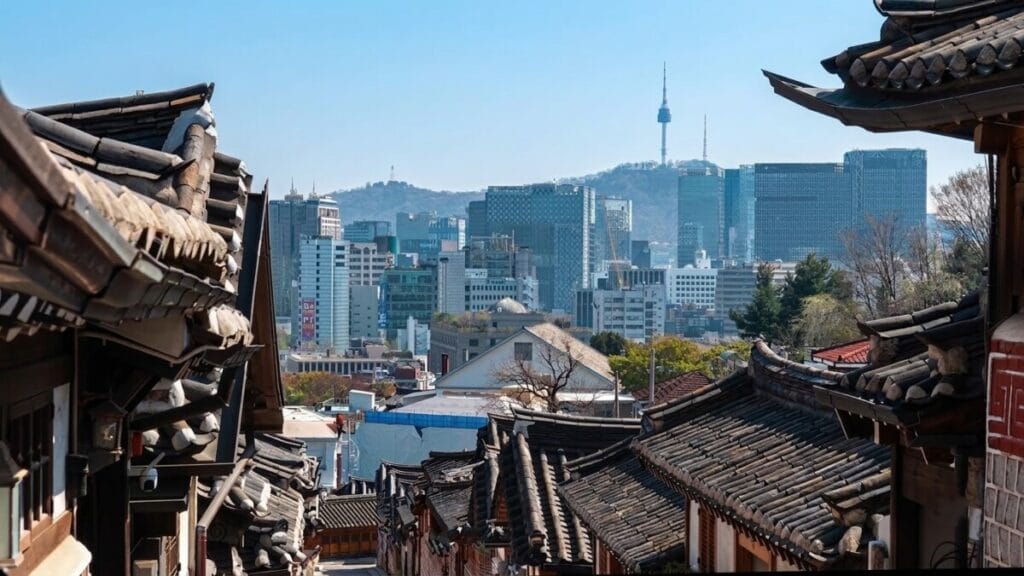
Bukchon Hanok Village is one of the most distinctive places to explore on foot in central Seoul. Located between Gyeongbokgung Palace and Changdeokgung Palace, this historic neighborhood is known for its traditional Korean houses, narrow residential alleys, small cultural spaces, and cafes housed in traditional-style buildings.
But Bukchon is more than a photo stop. It is also a residential neighborhood where people continue to live their daily lives. Visitors need to balance sightseeing with respect for local residents, especially in the designated tourist management areas where visiting hours are restricted.
This walking guide follows a route beginning at Anguk Station, continuing along Gyedong-gil into the traditional streets of Bukchon, and descending toward Samcheong-dong and the cultural attractions near central Seoul. Along the way, you can explore traditional architecture, visit a historic house, stop for coffee or tea, and discover how old Seoul and contemporary urban life coexist.
The original route includes personal observations about the atmosphere of Bukchon, including the contrast between quieter early-morning cafe visits and busier sightseeing periods. These observations are useful for planning, but conditions can vary by day and season.
Bukchon Hanok Village Walking Tour at a Glance

- Starting point: Anguk Station, Seoul Subway Line 3
- Suggested starting exit: Exit 3 for the Gyedong-gil approach
- Main areas: Gyedong-gil, Bukchon Hanok Village, Gahoe-dong, Samcheong-dong
- Main experiences: Traditional architecture, residential alleys, cultural sites, cafes, and neighborhood views
- Recommended approach: Explore at a relaxed pace and allow extra time for cafe stops and cultural attractions
- Important restriction: Designated tourist management areas have restricted visiting hours
- Best for: Travelers interested in traditional Korean architecture, neighborhood walks, photography, and cultural experiences
The route is best treated as a flexible walking itinerary rather than a timed tour. The distance and duration depend on which alleys you enter, whether you visit museums or historic houses, and how long you spend at cafes.
1. Start at Anguk Station and Walk Along Gyedong-gil
Anguk Station is a convenient starting point for exploring Bukchon. From Exit 3, head toward Gyedong-gil and the area around Changdeokgung Palace.
The neighborhood gradually changes as you move away from the main streets. Modern shops and coffee businesses share the area with traditional buildings, smaller workshops, and residential lanes.
Gyedong-gil is a useful introduction to Bukchon because it combines everyday neighborhood activity with the architectural character that attracts visitors to the area.
Rather than rushing straight to the most photographed alleys, take time to notice the details along the street. Rooflines, wooden doors, courtyard walls, and the relationship between newer businesses and traditional buildings help explain what makes Bukchon different from a purpose-built tourist attraction.
Practical tip: Check your route before entering the smaller residential lanes. Some streets lead uphill, and not every alley offers a direct connection to the next attraction.
2. Stop at Cafe Onion Anguk
Cafe Onion Anguk is a well-known cafe in the Bukchon area, popular with visitors interested in traditional Korean architecture and contemporary cafe culture.
Its setting combines a traditional-style building with a courtyard atmosphere, making it a natural stop for travelers who want to experience a modern cafe within a historic neighborhood.
The original article describes the cafe as particularly peaceful during an early weekday visit, with the courtyard becoming considerably busier later in the morning. That is a useful firsthand observation, although crowd levels can change depending on the day, season, and visitor demand.
If a quieter coffee break is important to you, an early visit on a weekday may be worth considering. However, confirm the cafe’s current opening hours before planning your morning around it.
Cafe Onion is optional rather than essential to the walking route. Travelers who prefer to spend more time exploring the architecture can skip the stop and continue into Bukchon.
3. Explore Gyedong-gil’s Food and Cafe Scene

One of the appealing aspects of Bukchon is the way its food and cafe businesses are integrated into the neighborhood.
Along and around Gyedong-gil, visitors can find contemporary cafes, restaurants, small shops, and businesses operating in buildings that reflect the area’s traditional character.
The original guide mentions Silla Jemyeon, known for noodle dishes, and Dotori Garden, a cafe associated with Greek yogurt and acorn-shaped pastries. It also points to smaller alleys where visitors may find Korean comfort food, including soft tofu dishes and dumplings.
These establishments can add a food-focused element to the walk, but individual business details should be checked before visiting. Opening hours, menus, waiting times, and operating status can change.
If you are visiting during a busy lunch period, consider deciding on a general dining area rather than relying on a single restaurant. This gives you more flexibility if a particular business is closed or has a long queue.
Bukchon is not a flat, purpose-built shopping district. Walking between cafes and restaurants may involve slopes, steps, and narrow streets, so allow time for the route itself rather than treating each stop as immediately adjacent.
4. Visit Bukchon Traditional Culture Center

The Bukchon Traditional Culture Center is a useful stop for travelers who want more context about the neighborhood beyond its appearance in photographs.
The center introduces aspects of traditional Korean residential culture and provides information about the historic surroundings. It can also serve as a point to pause and orient yourself before continuing through the area.
The center is located at 37 Gyedong-gil, making it a practical reference point when navigating the neighborhood.
Official Seoul Hanok information lists different operating hours for weekdays and weekends. Check the current schedule before visiting, particularly if you plan to arrive near closing time.
This stop is especially worthwhile for visitors interested in architecture and cultural context. If your main goal is simply to photograph the traditional streets, you may prefer to spend more time walking through the neighborhood instead.
5. Explore the Historic Gahoe-dong Alleys Respectfully
Gahoe-dong is one of the best-known areas within Bukchon for its concentration of traditional Korean houses and sloping residential lanes.
The appeal comes from the relationship between the tiled roofs, stone walls, narrow streets, and the surrounding cityscape. Unlike a reconstructed attraction, this is a living neighborhood, so the experience depends partly on how visitors behave.
Important Visiting Hours
Bukchon includes a designated Special Management Area where tourist visiting hours are restricted.
The official Seoul tourism information lists visiting hours of 10:00 AM to 5:00 PM for the restricted area. Visitors are prohibited from entering the designated area outside those hours.
This restriction should not be interpreted as meaning that every street throughout Bukchon has identical access rules. Check the official guidance and local signs to determine whether a particular lane falls within the restricted zone.
For planning purposes, visit the designated tourist area during the permitted hours and avoid treating early morning or evening as an opportunity to enter restricted residential lanes.
Respect Residents’ Privacy
People live in the houses surrounding these streets. Visitors should keep their voices low, avoid blocking entrances, take their rubbish with them, and never photograph private interiors through open doors or windows.
Large groups can create additional noise and congestion in narrow lanes. Smaller groups are more considerate and make it easier for residents to move around their neighborhood.
Photography is part of the attraction for many visitors, but it should not come at the expense of the people who live there.
Look Beyond the Most Famous Photo Spot
The best experience does not necessarily come from visiting one specific photo location.
Take time to observe the wider neighborhood, but stay on publicly accessible routes and follow posted restrictions. A quieter street may offer a more relaxed walk, although no particular lane should be assumed to be empty or accessible without checking the local situation.
The streets are not uniform in difficulty. Some sections involve uphill walking, and visitors who are uncomfortable with slopes or stairs should plan a shorter route.
6. Visit Baek In-je House
Baek In-je House is a historic residence that offers a more focused look at Korean domestic architecture in Bukchon.
Built in the early twentieth century, the house is notable for its scale and architectural features, including elements that reflect changes in Korean residential design during that period.
The property provides a useful contrast with the surrounding residential alleys. Instead of viewing traditional houses only from public streets, visitors can learn more about the layout and character of a historic residence through the museum’s visitor facilities and guided programs.
Opening Hours and Admission
According to the Seoul Museum of History’s official information:
- Opening hours: Tuesday through Sunday, 9:00 AM to 6:00 PM
- Last admission: 5:30 PM
- Admission: Free
- Regular closing days: Mondays and January 1
If a Monday falls on a public holiday, check the museum’s current notice for any changes.
General visitors can explore the grounds during operating hours, but access to some interior areas is associated with guided tours. Guided programs may require advance booking or on-site registration, depending on availability.
Check the official museum information before your visit if entering the house interiors is important to you.
Baek In-je House is particularly suitable for travelers who want to understand the architecture and history behind Bukchon’s appearance rather than simply walking through its streets.
7. Continue Toward Samcheong-dong
After exploring the traditional lanes, consider continuing toward Samcheong-dong.
This area provides a different perspective on central Seoul, with cafes, small businesses, cultural destinations, and streets that connect the historic neighborhood with the wider city.
The original walking route recommends descending toward Samcheong-dong and considering a traditional tea stop along the way. A tea house can be a good choice if you want a quieter break after walking through the more heavily photographed parts of Bukchon.
However, do not assume that every cafe or tea house mentioned in an older guide is currently operating with the same hours or menu. Check current information before making a specific business an essential part of your itinerary.
Jeongdok Public Library and Nearby Cultural Stops
Depending on your interests and available time, you can extend the walk toward Jeongdok Public Library and the nearby cultural institutions.
These stops are useful for travelers who enjoy combining architecture, neighborhood exploration, and quieter outdoor spaces. They also provide an alternative to spending the entire visit in the narrow residential alleys.
If you are planning to visit several cultural facilities, check each institution’s opening days and hours separately. Their schedules may differ, and a walking route should not assume that every stop will be open at the same time.
8. Finish Near the Seoul Museum of Craft Art
Travelers who want to extend the outing can continue toward the Seoul Museum of Craft Art and the surrounding streets near Anguk.
This is a natural way to connect the traditional atmosphere of Bukchon with Seoul’s contemporary cultural scene.
The Seoul Museum of Craft Art focuses on craft and design, making it a relevant addition for visitors interested in materials, traditional techniques, and Korean creative culture.
Whether you include the museum depends on how much time you have already spent walking and visiting cafes. If you have only a short window, it may be better to focus on Bukchon’s architecture and one cultural attraction rather than rushing through several destinations.
The original article also mentions a retro-style cafe experience near this part of the route. Its description of coffee served with separate sugar and creamer conveys the author’s personal appreciation for nostalgic cafe culture.
That detail is worth retaining because it gives the guide an individual perspective. However, travelers should verify the current location and operating status of any specific cafe before making it their final stop.
How Much Time Should You Allow?
The time required depends on how much of Bukchon you want to explore.
A short visit focused on the main streets and a few architectural viewpoints will require less time than a walk that includes a cafe stop, a historic house, the Traditional Culture Center, and additional cultural attractions.
For a comfortable itinerary, allow time for:
- Walking between the main areas.
- Exploring the traditional lanes without rushing.
- Stopping for coffee or tea.
- Visiting a cultural attraction if it is open.
- Taking breaks on uphill sections.
Do not treat the route as a race to complete every stop. Bukchon’s appeal comes partly from noticing the details of the neighborhood, and rushing between photo locations can undermine that experience.
The route’s total distance and walking time will also depend on the streets you choose and any temporary access restrictions. Use a current navigation map for the exact route on the day of your visit.
How to Get to Bukchon Hanok Village
The most convenient starting point for this itinerary is generally Anguk Station on Seoul Subway Line 3.
Exit 3 provides a useful approach to Gyedong-gil and the Bukchon area. If you plan to visit Baek In-je House first, Anguk Station Exit 2 is also a convenient option.
Bukchon is a neighborhood rather than a single attraction with one entrance. Your starting point should depend on which section you want to visit first.
For the simplest itinerary, begin around Gyedong-gil, continue into the accessible traditional streets, and then decide whether to extend the walk toward Samcheong-dong or the nearby cultural institutions.
Check current navigation information before setting out, especially if you intend to enter the designated tourist management area.
Is Bukchon Hanok Village Worth Visiting?
Bukchon is a strong choice for travelers who want to see traditional Korean architecture within an active urban neighborhood.
Its appeal lies in the combination of historic houses, sloping lanes, cultural facilities, and contemporary cafes. It is particularly rewarding for visitors who enjoy walking slowly and observing how traditional architecture fits into modern Seoul.
However, it may be less suitable for travelers who dislike uphill walking, prefer wide pedestrian streets, or want an attraction where every area is designed specifically for tourists.
The residential character of Bukchon is also an important consideration. Visitors should not expect unrestricted access to every alley, and the designated management area has specific visiting hours.
If you want a more structured cultural visit, Baek In-je House and the Bukchon Traditional Culture Center can provide useful context. If you prefer a relaxed neighborhood experience, focus on the accessible streets and leave time for a cafe stop.
Practical Tips Before You Go
Check access restrictions. The designated tourist management area has restricted visiting hours. Confirm the current rules before entering the residential lanes.
Wear comfortable shoes. The route includes slopes and may involve steps or uneven surfaces.
Avoid rushing. The walking time depends on how many side streets and cultural attractions you include.
Verify business hours. Cafe and restaurant schedules can change, particularly around holidays.
Respect private homes. Keep noise low, do not block entrances, and never photograph private interiors without permission.
Check museum schedules separately. Cultural facilities may have different closing days, tour schedules, and access conditions.
Keep the route flexible. If a street is restricted or a business is closed, continue to another publicly accessible section instead of trying to find an unofficial shortcut.
Frequently Asked Questions
Is Bukchon Hanok Village free to visit?
Walking through publicly accessible streets in Bukchon is generally free. Individual museums, cultural programs, or commercial businesses may have separate arrangements or charges, so check each destination before visiting.
What is the best subway station for Bukchon Hanok Village?
Anguk Station on Seoul Subway Line 3 is a convenient starting point. Exit 3 works well for the Gyedong-gil approach, while Exit 2 is useful for visitors heading toward Baek In-je House.
Can I visit Bukchon Hanok Village in the evening?
Access depends on the specific area. The designated Special Management Area has restricted visiting hours, listed by Seoul’s official tourism information as 10:00 AM to 5:00 PM. Do not assume that all residential lanes are open to tourists in the evening.
Is Bukchon Hanok Village suitable for a walking tour?
Yes, particularly for visitors interested in traditional architecture and neighborhood culture. However, some streets are uphill, and the route may not suit everyone who has difficulty walking on slopes or steps.
Should I visit Bukchon Hanok Village and a palace on the same day?
They can fit into the same day because Bukchon is located between Gyeongbokgung Palace and Changdeokgung Palace. The best combination depends on opening hours, the time needed for each visit, and your walking pace. Choose a realistic number of stops rather than attempting to see every attraction in one outing.
Final Thoughts
Bukchon Hanok Village is best experienced as a neighborhood to explore, not simply a collection of photo spots.
A walk from Anguk Station through Gyedong-gil and the traditional lanes, followed by a cultural stop and a gradual descent toward Samcheong-dong, offers a useful introduction to this part of Seoul.
The most rewarding itinerary will depend on your interests. Architecture enthusiasts may want to prioritize the historic streets and Baek In-je House, while travelers who enjoy cafe culture can build in time for coffee or traditional tea.
Above all, remember that Bukchon is home to local residents. Respecting access restrictions and private spaces is essential to enjoying the neighborhood responsibly.