Gyeongbokgung Palace is one of Seoul’s most recognizable historical landmarks. During special nighttime opening events, visitors can explore selected areas of the royal palace after dark and see its traditional architecture illuminated against the evening sky.
I visited Gyeongbokgung Palace, and the nighttime viewing experience is a particularly interesting way to explore Seoul’s royal history. The palace offers a different atmosphere in the evening from the one visitors experience during ordinary daytime sightseeing.
However, nighttime viewing is not available every day. It is organized as a seasonal event, with specific opening dates, ticket arrangements, and areas available for visitors. Planning ahead is therefore essential, especially for international travelers who may be unfamiliar with Korea’s ticketing systems.
This guide explains what to know before visiting, which palace buildings to look for, how to plan your evening, and where to check the latest admission information.
What Is Gyeongbokgung Palace Night Viewing?

Gyeongbokgung Palace was the main royal palace of the Joseon Dynasty, which ruled Korea from 1392 to 1910.
Located in northern central Seoul, the palace is known for its traditional gates, courtyards, royal halls, residential buildings, and landscaped gardens. It is also an important place to learn about the history and architecture of Korea.
The palace’s nighttime viewing event gives visitors an opportunity to explore selected areas after sunset. Under the evening lighting, the wooden buildings, tiled roofs, and painted architectural details create a different visual experience from daytime visits.
The event is especially appealing to travelers interested in Korean history, traditional architecture, photography, and cultural experiences.
One important point is that nighttime viewing is separate from the palace’s regular daytime admission. The dates, opening hours, and ticket arrangements depend on the official seasonal announcement.
Before making plans, check the latest information from the Korea Heritage Service’s Royal Palaces and Tombs Center.
When Can You Visit Gyeongbokgung Palace at Night?
Gyeongbokgung Palace nighttime viewing is organized during designated periods rather than operating every evening throughout the year.
In 2026, the second-half nighttime viewing event ran from September 2 through October 2. Visitors were admitted between 7:00 PM and 9:30 PM, with the last admission at 8:30 PM. The event did not operate on Mondays or Tuesdays.
Those dates have now passed. Travelers planning a future visit should not rely on the 2026 autumn schedule and should wait for the next official announcement.
The palace may have different opening arrangements for regular daytime admission, special nighttime events, and other cultural programs. These schedules should not be treated as interchangeable.
Where to Check the Latest Schedule
The most reliable place to check future nighttime viewing dates is the official Royal Palaces and Tombs Center website.
Look for an announcement specifically about Gyeongbokgung Palace nighttime viewing. Check all of the following before choosing your travel date:
- The first and last dates of the event
- Days when nighttime viewing is unavailable
- Opening and last-admission times
- Ticket prices and reservation requirements
- Areas of the palace open during the event
- Special performances or additional programs
- Rules for free admission and same-day ticket sales
These details can change between events, so information from a previous season should be treated as a reference rather than a guarantee.
How to Get Tickets for Nighttime Viewing
Ticket arrangements depend on the specific event. Some visitors may need an advance reservation, while designated admission arrangements may be available for foreign visitors or people who qualify for free admission.
For the 2026 autumn event, advance reservations were handled through NOL Ticket. A limited number of same-day tickets were also made available to foreign visitors at the ticket office.
These were arrangements for that particular event. Check the next official announcement before assuming that the same booking process, ticket allocation, or admission rules will apply.
What International Visitors Should Know
If you are visiting Seoul from overseas, check whether the next event offers on-site ticket sales for foreign passport holders.
If same-day admission is available, confirm the required identification, ticket limit, sales location, and opening time. Bring your passport or other documentation specified in the official notice.
Do not assume that a ticket will be available simply because you arrive at the palace entrance. Popular dates may attract substantial demand.
If advance reservations are required, follow the official booking instructions and confirm whether the reservation system supports your preferred payment and verification method.
Can You Enter for Free Wearing Hanbok?
Hanbok, Korea’s traditional clothing, is a popular choice for visitors exploring the palace.
Under the 2026 autumn nighttime viewing rules, visitors wearing qualifying Hanbok could enter without purchasing a regular ticket. However, free admission depends on meeting the official clothing guidelines.
Not every outfit inspired by traditional Korean clothing necessarily qualifies. Check the applicable rules and examples before renting or purchasing a Hanbok specifically for free admission.
Other groups may also qualify for free admission under the event’s rules, including certain age groups and visitors with eligible status.
For your planned visit, consult the official announcement rather than relying on a general statement that Hanbok always guarantees entry.
What to See During Gyeongbokgung Palace Night Viewing
The nighttime viewing route may include several important areas of the palace. The buildings and gardens below are particularly worthwhile to learn about before your visit.
The exact areas open at night depend on the event, so confirm the current visitor map before planning a detailed route.
1. Geunjeongjeon Hall: The Main Throne Hall
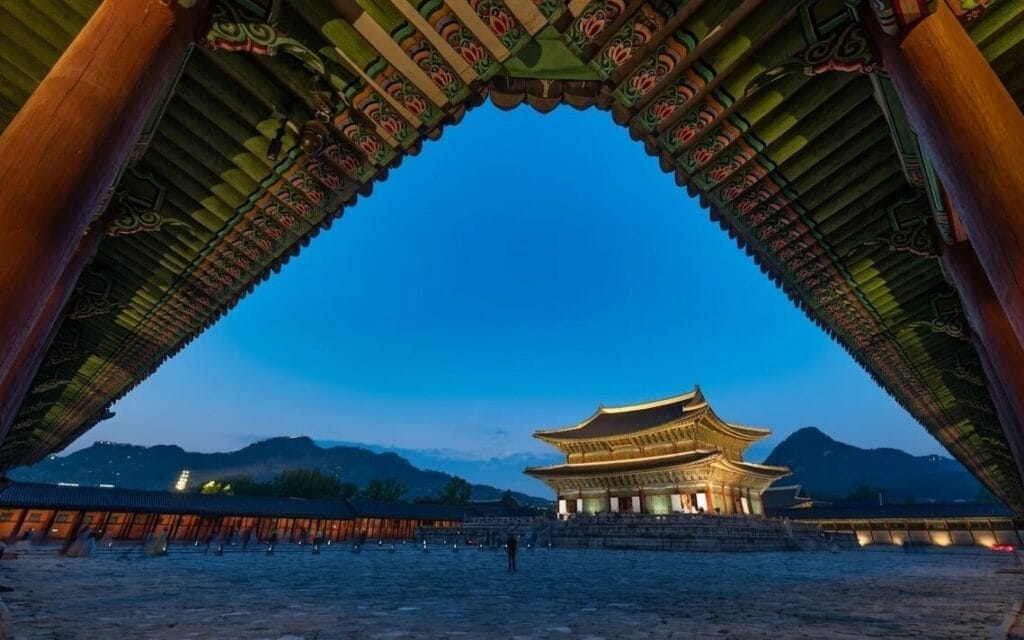
Geunjeongjeon Hall is the main throne hall of Gyeongbokgung Palace.
It was used for important royal ceremonies and official state occasions. Its elevated stone platform, spacious courtyard, and traditional roof structure make it one of the palace’s most recognizable buildings.
During nighttime viewing, the illuminated architecture offers opportunities to observe details that may look different under daylight.
Take time to look at the hall as a whole rather than concentrating only on close-up photographs. The surrounding courtyard and the relationship between the building and its gates are also important parts of the architectural composition.
If photography is a priority, be considerate of other visitors and follow any restrictions posted around the buildings.
2. Gyeonghoeru Pavilion: A Landmark Beside the Pond

Gyeonghoeru Pavilion stands beside a large pond within the palace grounds.
Historically, the pavilion was used for royal banquets and receptions for important guests. Its open architectural design and position beside the water make it one of the most distinctive structures in Gyeongbokgung Palace.
The pond can provide attractive reflections when the water and lighting conditions are suitable.
For photographers, this area is worth including in the route if it is open during the nighttime event. Reflections depend on factors such as wind, water movement, lighting, and weather, so they should not be expected to look identical on every visit.
3. Sajeongjeon Hall: The King’s Official Working Space

Sajeongjeon Hall served as a place where the king handled official affairs.
It is part of the palace’s administrative area and helps visitors understand that Gyeongbokgung was not simply a royal residence. It was also a center of government during the Joseon Dynasty.
When exploring the palace, consider how the different buildings served different functions. Large ceremonial halls, administrative spaces, and private residential areas were arranged according to their roles within the royal court.
The buildings are easier to appreciate when you understand their historical purposes rather than treating every structure as an interchangeable photo background.
4. Gangnyeongjeon and Gyotaejeon: The Royal Residential Areas

Gangnyeongjeon was the king’s main residential building, while Gyotaejeon was associated with the queen’s living quarters.
These buildings provide insight into the more private side of royal life.
Their architectural features differ from those of the main ceremonial halls. The layout and design of the residential areas reflect the way the palace was organized around royal duties, daily routines, and household life.
If these buildings are included in the nighttime viewing route, they are worth seeing as part of a broader understanding of the palace rather than as isolated attractions.
5. Amisan Garden: Decorative Chimneys and Traditional Design

Amisan Garden is located behind Gyotaejeon, in the area associated with the queen’s residential quarters.
The garden is known for its ornamental chimneys, which are decorated with traditional patterns and auspicious motifs.
These features show how practical elements of traditional architecture could also be carefully designed as decorative objects.
Because the garden and its access arrangements may vary according to the event, check whether it is included in the nighttime viewing area before making it a central part of your route.
How to Plan Your Evening Visit
A little planning can make nighttime viewing more enjoyable, especially if you want to take photographs or explore the palace without rushing.
Arrive Before Your Scheduled Entry
If you have a reservation, arrive early enough to locate the correct entrance and follow the ticket instructions.
For events with on-site ticket sales, confirm when ticket sales begin and whether queues are expected. Do not assume that arriving shortly before the opening time will guarantee admission.
Choose Your Priorities
The palace contains many buildings and courtyards. Rather than trying to photograph every structure, decide which areas matter most to you.
For example, you might prioritize Geunjeongjeon Hall for its grand architecture, Gyeonghoeru Pavilion for its waterside setting, or Amisan Garden for its decorative details.
The best route depends on the areas open during your chosen event and how much time you want to spend at each location.
Allow Time for Photography
The changing light around sunset can create a different atmosphere from the fully illuminated palace later in the evening.
However, the exact sunset time changes throughout the year. Cloud cover and weather conditions also affect the appearance of the sky.
If you want photographs during twilight, check the sunset time for your travel date and compare it with the official admission hours.
Do not rely on a sunset schedule from an earlier month or year.
Dress for an Outdoor Visit
Nighttime viewing takes place outdoors. Even when the day has been warm, the temperature may feel cooler after sunset.
Wear comfortable shoes because the visit involves walking between buildings and across courtyards. If rain is expected, bring suitable protection and check the event’s instructions.
The palace grounds can be dark in some areas, so pay attention to the path and follow signs or staff directions.
Getting to Gyeongbokgung Palace
Gyeongbokgung Palace is accessible by public transportation from many parts of Seoul.
By Subway
Gyeongbokgung Station on Subway Line 3 is a convenient option for reaching the palace area.
Gyeongbokgung Palace Station exits and the route to the entrance should be checked using a current navigation app before traveling. Walking distance depends on the entrance being used and the event’s admission arrangements.
Gwanghwamun Station on Line 5 may also be useful if you want to explore Gwanghwamun Square before or after the palace visit.
By Bus
Several city bus routes serve the Gyeongbokgung and Gwanghwamun area.
Because routes and stops can change, use a current navigation service to select the most convenient bus from your hotel or previous attraction.
What About Parking?
If you plan to drive, check current parking arrangements and availability before leaving. Parking near popular central Seoul attractions can be limited during busy periods.
For many visitors, the subway is a practical option because it avoids the need to find parking in a crowded central district.
Can You Visit Gyeongbokgung Palace and Other Attractions on the Same Evening?
Yes, depending on the event schedule and how much time you want to spend at the palace.
Gwanghwamun Square is nearby and can be combined with a visit to the palace area. Cheonggyecheon Stream is another option for travelers who want to continue walking through central Seoul.
If you are interested in Korean food, you can also plan a meal before or after the palace visit. However, check restaurant opening hours and allow enough time to reach the palace entrance before your scheduled admission.
Do not make a tightly packed itinerary based on the assumption that nighttime viewing operates every evening. Confirm your admission date first, then arrange other activities around it.
Practical Tips for a Better Visit
1. Check the Official Announcement
The event’s dates, admission hours, prices, and ticket rules can change. Use the official announcement for your travel season.
2. Confirm Which Areas Are Open
Not every building or garden is necessarily accessible during nighttime viewing. Review the event map and plan around the areas that are actually open.
3. Keep Your Ticket and Identification Ready
If your admission arrangement requires a reservation confirmation or identification, have it available before reaching the entrance.
4. Be Considerate When Taking Photographs
The palace is a cultural heritage site and a popular attraction. Avoid blocking narrow paths, entrances, or other visitors’ views while taking pictures.
5. Prepare for Outdoor Conditions
Bring comfortable walking shoes and clothing appropriate for the weather. If rain is expected, check the event notice and prepare accordingly.
6. Do Not Rely on Old Ticket Information
Search results and older travel guides may show dates or prices from previous seasons. Always confirm the information for your intended visit.
Frequently Asked Questions
Is Gyeongbokgung Palace Night Viewing Available Every Day?
No. Nighttime viewing is organized during designated periods. The operating dates and closed days depend on the event announcement.
How Much Does Nighttime Viewing Cost?
The ticket price depends on the event’s official rules. For example, the 2026 autumn event listed an admission fee of ₩3,000 for standard paid admission. Check the next event’s official notice before relying on this amount.
Can Foreign Tourists Buy Tickets at the Gate?
The 2026 autumn event offered a limited number of same-day tickets for foreign visitors. Whether the same arrangement will be available for a future event must be confirmed through the official announcement.
Can I Visit for Free Wearing Hanbok?
Qualifying Hanbok may allow free admission under the event’s rules. Check the current clothing guidelines to ensure your outfit meets the requirements.
Which Areas Should I Prioritize?
Geunjeongjeon Hall, Gyeonghoeru Pavilion, and Amisan Garden are among the notable areas to look for when they are included in the nighttime route. Your priorities should depend on the current event map and your interests.
Is the Palace Worth Visiting at Night?
If you are interested in Korean history, traditional architecture, or evening photography, nighttime viewing can be a rewarding addition to a Seoul itinerary. Its availability is limited, however, so planning ahead is essential.
Final Thoughts: Experiencing Gyeongbokgung Palace After Dark
Gyeongbokgung Palace is an important destination for understanding Seoul’s royal history. Its ceremonial halls, residential buildings, and landscaped spaces tell different parts of the story of the Joseon Dynasty.
A nighttime visit offers another way to appreciate these surroundings. Illuminated buildings and the evening atmosphere can make the palace feel different from a daytime visit, while the seasonal format gives travelers a reason to plan their trip carefully.
I visited Gyeongbokgung Palace, and I recommend considering its nighttime viewing if your travel dates coincide with an official event. Before making arrangements, confirm the schedule, ticket requirements, and open areas through the official source.
With the right preparation, a visit to Gyeongbokgung Palace can be a meaningful part of exploring Seoul’s history and traditional architecture.