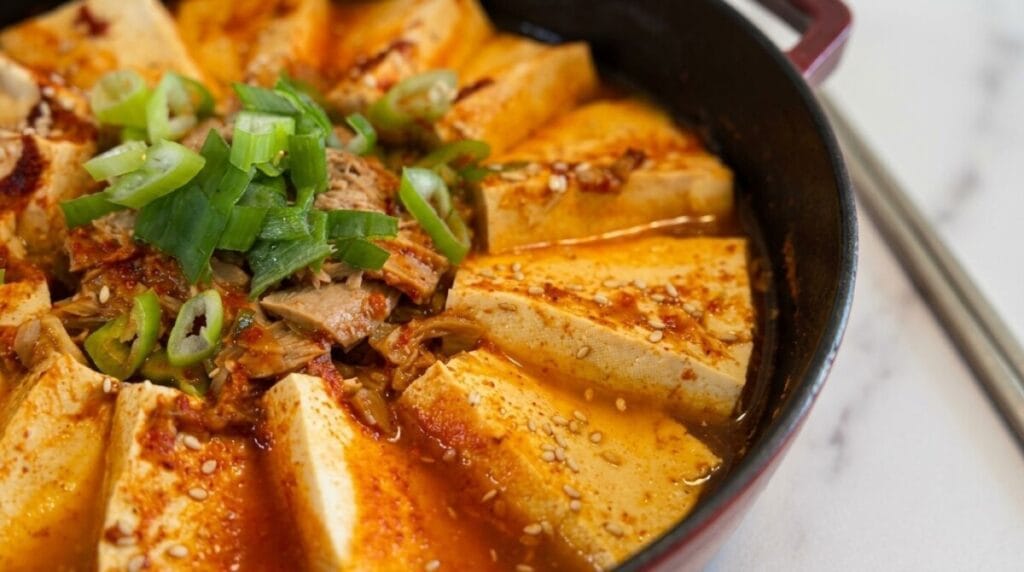
If you are familiar with Korean cuisine, you have likely heard of Jjigae (stew) and Guk (soup) — perhaps even Kimchi Jjigae, one of the most iconic examples. But there is another beloved category of local comfort food that sits in a league of its own: Tuna Jjageuli (참치 짜글이). Originating from countryside home kitchens, this Tuna Jjageuli is a thick, highly concentrated stew with minimal broth, slow-simmered until the ingredients melt into a rich, spoonable gravy.
As a Korean local who grew up enjoying authentic home-cooked meals and has spent years replicating traditional family recipes, this Tuna Jjageuli is my absolute ultimate comfort food when the pantry is nearly empty.
By combining standard pantry staples—canned tuna and a fresh block of tofu—with a robust, garlic-infused chili paste, this dish transforms simple ingredients into an explosive flavor experience. The natural oils of the tuna blend with the savory paste, infusing every pore of the soft tofu with deep umami. It is an incredibly fast, budget-friendly, and hearty one-pot meal that captures the true essence of Korean everyday home cooking.
The Local Expertise: Layering Flavors in a Low-Moisture Stew
Unlike a traditional Kimchi or Doenjang stew where ingredients swim in an abundance of broth, a Tuna Jjageuli depends entirely on concentrated flavor extraction. Because you use very little water, you must rely on the natural moisture of your vegetables to create the base.
To prevent your rich seasoning paste from scorching at the bottom of the pot while drawing out maximum sweetness, follow this traditional layering technique:
1. The Vegetable Foundation Rule
Never throw all your ingredients into the pot haphazardly. Always slice a generous amount of sweet yellow onions and zucchini and lay them flat at the very bottom of your pot.
- Why this works: As the pot heats up, these water-dense vegetables release their natural juices directly onto the cooking surface, acting as a protective fluid barrier that gently steams the tofu and meat above while infusing the sauce with a beautiful, natural sweetness.
2. Don’t Drain the Tuna Oil Completely
Many western recipes advise draining canned tuna thoroughly to cut back on grease.
- The Local Secret: For an authentic Korean fish or tuna stew, leave about half of the natural canning oil in the mix. This oil contains a massive concentration of fish umami. When simmered together with Gochujang (chili paste) and Doenjang (soybean paste), the oil emulsifies into the broth, giving the stew its characteristically velvety, full-bodied texture that water alone can never achieve.
This isn’t just a Korean trick — food writers have long noted that the oil in canned fish carries a concentrated dose of the fish’s own flavor, making it a natural flavor booster rather than something to pour down the drain.
Ingredients & Substitute Shopping Guide for Foreigners
This rustic dish is highly adaptable, making it the perfect entry point for cooks who don’t have access to an specialized Asian market.
Essential Ingredients
- Canned Tuna (in Oil preferred): 1 standard can (approx. 150g / 5 oz).
- Firm or Medium-Firm Tofu: 1 block (approx. 300g / 10 oz), sliced into bite-sized rectangles.
- Sweet Onion: 1 large, coarsely chopped.
- Zucchini or Grey Squash: 1/2, sliced into half-moons.
- Green Onions / Scallions: 2 stalks, cut into 1-inch lengths.
- Fresh Red or Green Chili: 1, sliced on a diagonal (optional, for extra heat).
- Water or Dashi Broth: 1 to 1.5 cups (just enough to partially submerge the tofu).
The Robust Jjageuli Paste
- Korean Chili Flakes (Gochugaru): 2 tablespoons.
- Korean Chili Paste (Gochujang): 1 tablespoon.
- Korean Soybean Paste (Doenjang): 1/2 tablespoon (the secret key to adding an earthy, savory base note).
- Regular Soy Sauce: 1.5 tablespoons.
- Minced Garlic: 1 large tablespoon.
- Sugar or Rice Syrup: 1/2 teaspoon (just a touch to soften the sharp saltiness).
- Black Pepper: A generous pinch.
💡 Expat Shopping Tip & Substitute: While canned tuna is the local household favorite, you can substitute it seamlessly with canned salmon, mackerel, or even ground pork. If you do not have traditional Korean Doenjang, a mild Japanese dark miso paste works beautifully as an alternative to anchor the deep savory notes of the chili paste.
Step-by-Step Cooking Instructions
Step 1: Mix the Paste and Prep Vegetables
- Coarsely chop your sweet onion and slice the zucchini into half-moons. Cut the tofu into 1/2-inch thick bite-sized rectangles.
- In a small bowl, thoroughly combine all the sauce ingredients (Gochugaru, Gochujang, Doenjang, soy sauce, minced garlic, sugar, and black pepper) into a thick red paste.
Step 2: The Strategic Layering
- In a small, deep skillet, pot, or traditional Korean earthenware bowl (Ttukbaegi), spread the chopped onions and zucchini evenly across the bottom.
- Arrange the sliced tofu rectangles neatly over the vegetable bed.
- Open your canned tuna, drain away half of the excess surface oil, and spoon the tuna chunks directly into the center of the tofu ring.
- Dollop the rich seasoning paste right on top of the tuna.
Step 3: The Concentrated Simmer
- Gently pour 1 cup of water (or kelp broth) around the edges of the pot, ensuring you do not wash the paste off the top of the tuna. The liquid should just barely reach the top of the tofu.
- Bring the pot to a boil over medium-high heat. Once it bubbles vigorously, use a spoon to gently break up the seasoning paste, letting it bleed into the surrounding water.
- Reduce the heat to medium-low, cover with a lid, and let it simmer for 12 to 15 minutes. The vegetables will shrink, releasing their juices, and the broth will turn thick and glossy.
Step 4: The Open-Flame Reduction
- Remove the lid. Drop in the green onions and sliced chilis.
- Let the stew simmer uncovered for an additional 3 to 4 minutes, occasionally spooning the bubbling red sauce over the tops of the tofu pieces. Once the broth has reduced into a thick, jammy gravy that lines the pan, turn off the heat and serve immediately.
How to Eat Tuna Jjageuli Like a Local
In Korea, a Tuna Jjageuli is never treated like a clean soup to be sipped from a bowl; it is designed to be highly interactive and messy.
- The Rice Smother Protocol: Give every guest a wide, shallow bowl filled with hot, freshly steamed white rice. Instead of eating the stew as a side dish, take a large spoon, scoop deep to get the soft onions, seasoned tofu, and savory tuna chunks, and dump it directly onto your rice.
- The Mash and Mix Technique: Use your spoon to gently mash the tender tofu and sweet onions right into the rice grain, mixing it thoroughly with the concentrated red gravy until every kernel is stained crimson. Top each bite with a piece of crisp seaweed paper (Gim) or a slice of matured Kimchi for the ultimate comforting explosion of flavors.